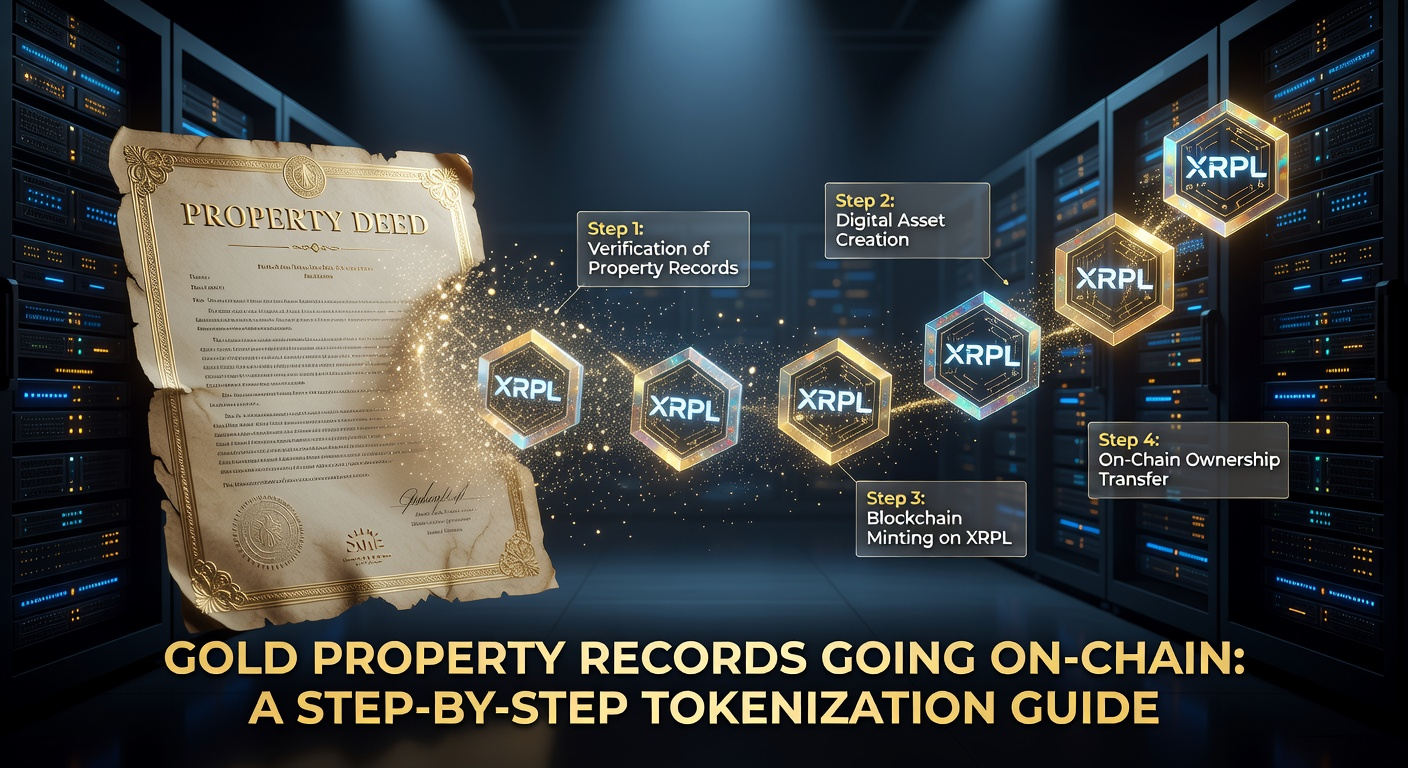
How to Tokenize Real Estate on XRPL: The Complete Operational Guide
Real estate tokenization is live — not theoretical. Properties worth billions are already operating this way. The technical side is straightforward on XRPL. The legal and structural side requires deliberate execution. Here is the complete operational sequence.
Whether you're tokenizing a single rental property or a $50 million commercial portfolio, the foundational process is the same: establish the legal container, configure the compliance structure, deploy the tokens, and manage the investor relationship. XRPL handles the on-chain mechanics. Your legal counsel handles the securities compliance. The integration between those two layers is what this guide covers.
The Case for Tokenizing Real Estate
Real estate has four structural problems that tokenization directly addresses: illiquidity (sales take months), artificial divisibility floors (you can't buy 0.1% of a building through traditional means), opaque and slow settlement (weeks of escrow and title transfers), and global access limitations (most international investors can't efficiently own US real estate directly).
Tokenization converts a property's equity into transferable, fractional digital representations. Once on-chain, those tokens settle in 3–5 seconds, trade against any liquidity source globally, and distribute income automatically to hundreds of holders at near-zero cost. The property itself is unchanged; its financial accessibility and liquidity profile are transformed.
Step 1: Legal Entity Formation
The LLC Model (Most Common)
A Limited Liability Company holds the property. Token holders own membership interests in the LLC. The LLC is the legal owner of record — the token represents a fractional claim on the LLC's assets and income. Delaware and Wyoming are popular formation states for asset protection and tax flexibility.
The Operating Agreement defines everything: profit distribution mechanics, voting rights, transfer restrictions, manager authority, exit mechanisms, and how the tokenized interests relate to traditional membership interests. This document is the legal foundation that gives your tokens meaning in court.
Why Not a Traditional REIT?
REITs require SEC registration, quarterly reporting, and ongoing compliance overhead that makes them appropriate for large portfolios but cost-prohibitive for single-property or small-portfolio offerings. The LLC structure with Reg D exemption is the standard path for most tokenized real estate projects under $50M.
Step 2: Regulatory Framework Selection
Tokenized real estate is a security in virtually all configurations. The Howey Test is satisfied: investment of money + common enterprise + expectation of profits + from the efforts of others (the property manager/operator). This means choosing a registration exemption.
Regulation D Rule 506(c) — The Standard Path
Permits unlimited accredited investors. Allows public solicitation and advertising. Requires verification of accredited status (income or net worth documentation through services like Verify Investor). No limit on raise size. No ongoing SEC reporting beyond Form D. This is the most commonly used exemption for tokenized real estate.
Regulation A+ — For Larger Public Raises
Allows up to $75M annually from the general public (including non-accredited investors). Requires SEC qualification, audited financials, and ongoing semi-annual reporting. The compliance cost makes this appropriate only for offers exceeding approximately $10M where broader investor access justifies the overhead.
Regulation CF — For Community or Fan-Based Raises
Permits up to $5M from non-accredited investors through registered crowdfunding portals (Republic, Mainvest, etc.). The portal handles SEC compliance and investor verification. Less flexible than 506(c) but provides access to a much broader investor pool for smaller offerings.
Step 3: Asset Valuation and Token Structuring
Professional Appraisal
Commission a licensed MAI appraiser. The appraisal establishes the property value that becomes the denominator for your token pricing. It goes into the PPM as the primary valuation evidence. Investors will scrutinize this — choose a reputable firm.
Token Supply and Pricing
Common approach: 1 token = $1 of equity. A $2.5M property tokenizing 60% equity issues 1.5 million tokens at $1 each, raising $1.5M. Simple, intuitive, easy for investors to calculate their proportional ownership. Alternatively: 1 token = 1 share, with share count set arbitrarily (mimics corporate structure). Avoid complex fractional structures that make proportional ownership calculations non-obvious.
Partial vs. Full Tokenization
You don't have to tokenize 100%. Retaining 20–40% equity aligns your interests with investors, satisfies many institutional investor requirements, and gives you flexibility to raise additional capital in future tranches as the property appreciates.
Step 4: XRPL Token Deployment
The XRPL deployment follows the standard two-wallet architecture — issuing account and distribution account. For regulated real estate securities, RequireAuth is mandatory: no holder can receive tokens without explicit authorization from the issuing account, which you grant only after verifying accredited status.
Configuration checklist before deployment:
- Issuing account funded and flags configured (RequireAuth, NoRipple)
- Distribution account funded and trust line to issuer established
- Token metadata (XLS-24d format) hosted and linked via domain field
- RequireAuth confirmed active — verify in XRPL explorer before any distribution
- Clawback enabled (if your legal counsel advises this for regulatory compliance)
- Distribution deep links generated and tested in all three supported wallets
Step 5: Investor Onboarding and Distribution
The investor onboarding flow for a Reg D 506(c) real estate token:
- Investor completes online interest form and receives PPM
- Investor signs subscription agreement and provides accreditation documentation
- Accreditation verified by third-party service (Verify Investor, PASS ID, etc.)
- Investor funds subscription (wire, ACH, or RLUSD on-chain)
- Investor receives trust line link — opens their chosen XRPL wallet (XAMAN, GemWallet, Crossmark) with trust line pre-populated
- Issuing account approves trust line (authorization of the specific investor's wallet address)
- Tokens distributed to investor's authorized wallet
After the offering closes, ongoing management is primarily operational: collect rent, pay expenses, calculate distributable income, send RLUSD payments to all holder wallets on the agreed distribution schedule (monthly, quarterly). Secondary market trading — if permitted under your offering terms and after applicable lock-up periods — happens on the XRPL native DEX without any additional configuration.
Ongoing Compliance Obligations
A Reg D offering is not a "file once and forget it" structure:
- Annual updating of investor contact information and capitalization table
- Distribution of K-1 tax documents if structured as pass-through LLC
- State securities notice filing renewals in applicable jurisdictions
- Maintaining records of all investor communications
- Transfer restriction enforcement — any secondary market transfers must maintain accredited investor status
XRPL's RequireAuth means every secondary market transfer requires your authorization of the new holder's trust line. This is operationally intensive for actively trading tokens but provides the compliance infrastructure that regulators expect for restricted securities.
The Economic Argument for XRPL Over Other Chains
Consider a $2M property tokenized into 1.2M tokens distributing rental income quarterly for 10 years. On XRPL at 400 holders: total distribution cost over 10 years is approximately $1.60. The same distribution schedule on Ethereum mainnet: $80,000–$400,000 depending on gas conditions. The infrastructure cost difference alone is a meaningful fraction of total returns for smaller offerings.
This is not a hypothetical — it's the operational economics that real estate syndicators are running. When the choice is spend $0 versus $400,000 on transaction fees over a 10-year hold period, the chain selection is a straightforward financial decision.
Deploy Your Real Estate Token
OnRampDLT provides two-wallet XRPL deployment, RequireAuth investor management, RLUSD distribution flows, and trust line onboarding — configured for securities compliance. Start on testnet before going live.
Start Building →