The Howey Test & Token Classification: Is Your Token a Security?
A plain-English breakdown of the Howey Test and how it applies to token issuers in 2026. Understand whether your token is a security, a utility, or something in between — before you launch.
This article is for informational and educational purposes only and does not constitute legal advice. Consult a qualified securities attorney before structuring any token offering.
Before you issue a token — on XRPL, Ethereum, or any other chain — there is one question that determines your entire legal architecture: is your token a security? Get this wrong and you're not just in regulatory gray area. You're potentially facing SEC enforcement, rescission liability, and the unwinding of your entire offering.
The framework that answers this question is 78 years old, came from a case about orange groves in Florida, and still governs every token issued in the United States today.
What Is the Howey Test?
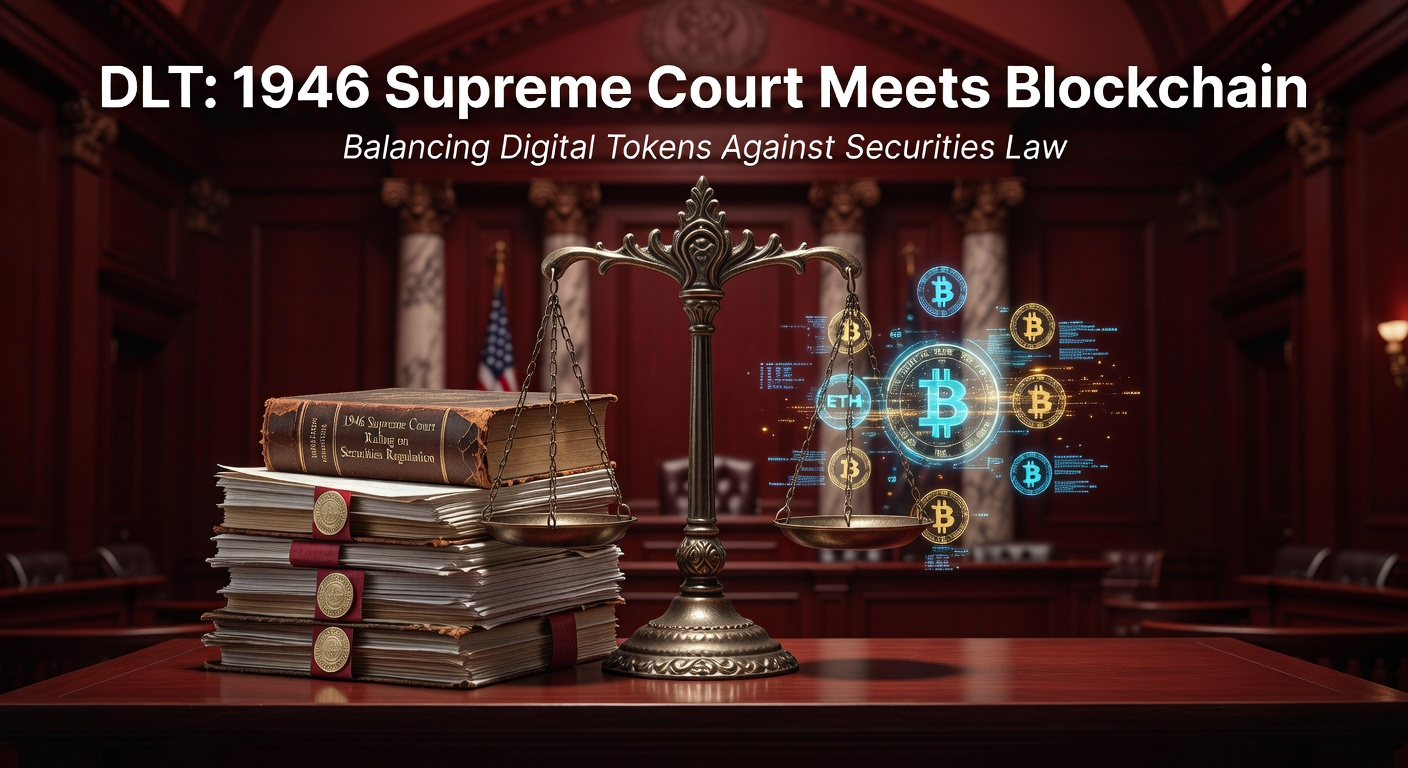
In 1946, the Supreme Court ruled in SEC v. W.J. Howey Co. that an "investment contract" — and therefore a security — exists when there is:
- An investment of money
- In a common enterprise
- With an expectation of profits
- Derived from the efforts of others
All four prongs must be satisfied for the instrument to qualify as a security under federal law. The SEC has applied this test to tokens consistently since 2017, and courts have largely agreed with that application.
Breaking Down Each Prong
1. Investment of Money
This is almost always satisfied in token offerings. If someone pays ETH, XRP, USDC, or fiat to receive your token, prong one is met. The courts have extended "money" broadly — even non-monetary contributions like services or property can count if they have economic value.
2. Common Enterprise
Courts have interpreted "common enterprise" in two ways: horizontal commonality (investors pool funds, sharing profits and losses together) and vertical commonality (each investor's return is tied to the promoter's efforts). Most token offerings satisfy at least one of these. If the value of your token depends on what your company does, you have vertical commonality.
3. Expectation of Profits
This is where many project founders try to engineer their way out of Howey — and where most fail. "Profits" includes capital appreciation, dividends, revenue sharing, and any other economic return. If you market your token with price targets, yield projections, or any language suggesting holders will make money, prong three is almost certainly met. The SEC looks at economic reality, not what you call it.
4. Efforts of Others
If the value of the token depends primarily on what your team builds, maintains, or operates — rather than the independent efforts of a decentralized network — this prong is met. For most early-stage token projects, the founding team IS the enterprise. That means prong four is satisfied by default.
Token Classification: A Practical Framework
| Token Type | Typical Howey Result | Regulatory Path |
|---|---|---|
| RWA Token (real estate, debt, equity) | Security — all 4 prongs met | Reg D, Reg A+, or registered offering |
| Revenue-sharing token | Security — profit expectation clear | Reg D |
| Governance token (with economic rights) | Likely security | Reg D or legal opinion required |
| Fully functional utility token | May not be a security | Legal opinion strongly recommended |
| Payment stablecoin (1:1 fiat-backed) | Generally not a security | State money transmitter licensing |
| Fully decentralized network token (BTC, ETH post-merge) | Not a security (SEC position) | Commodity regulation (CFTC) |
The "Utility Token" Defense — Why It Usually Fails
The most common attempt to avoid Howey is labeling a token a "utility token" — one that grants access to a platform or service rather than an investment return. The strategy can work, but only when the utility is genuine and present at launch. Courts and the SEC look at:
- Is the platform functional at time of sale? If you're selling tokens before the product exists, buyers are speculating on your team's execution — not using a utility.
- Is the utility the primary marketing message? If your pitch leads with price appreciation and ends with "oh, also you get platform access," you've lost the utility defense.
- Can tokens be used immediately? If holders must wait for a network launch, vesting schedule, or future development, the investment expectation dominates.
"The label you put on a token is irrelevant. What matters is how it was sold, to whom, and what buyers reasonably expected." — SEC, consistent enforcement position since 2017
What Changes in 2026
The regulatory environment has shifted meaningfully since 2023. The SEC's resolution of the Ripple case in 2025 established that secondary market sales of tokens on public exchanges don't automatically constitute securities transactions — even if the original ICO did. The FIT21 Act framework, advancing through Congress, creates a clearer path for tokens to transition from security classification to commodity classification as networks decentralize.
But for token issuers launching today with centralized control, professional teams, and investor-facing economics — Howey still applies in full. The new frameworks are a path forward, not a present-day exemption.
If Your Token Is a Security: Your Options
A security classification isn't a dead end. It's a compliance requirement. The most practical paths for token issuers:
- Reg D 506(b): Private placement to accredited + up to 35 sophisticated investors. No public advertising. Fast, low-cost. Best for known investor networks.
- Reg D 506(c): Accredited investors only, but you can publicly advertise. Must verify accreditation. Best for token offerings with broad outreach.
- Reg A+: Up to $75M raise, non-accredited investors allowed, SEC-reviewed offering circular. More expensive but broader reach.
- Reg CF: Up to $5M via crowdfunding portals. Limited use for token offerings but growing.
The Non-Negotiable: Get a Legal Opinion
Every token issuer operating in the U.S. should have a written legal opinion from qualified securities counsel on file before the first sale. This isn't optional compliance theater — it's your primary defense in the event of an SEC inquiry, investor dispute, or secondary market complication. The opinion should address Howey directly, document your factual basis for your classification conclusion, and be updated if your token's economics or marketing materially change.
The cost of a legal opinion ($5,000–$25,000 depending on complexity) is a rounding error compared to the cost of an SEC enforcement action ($500,000+) or a rescission demand from investors.
Issue tokens on XRPL with built-in compliance controls
OnrampDLT provides the on-chain infrastructure for compliant token issuance — trust line controls, Require Authorization, and non-custodial signing via Xaman. You bring the legal wrapper.
Explore OnrampDLT →