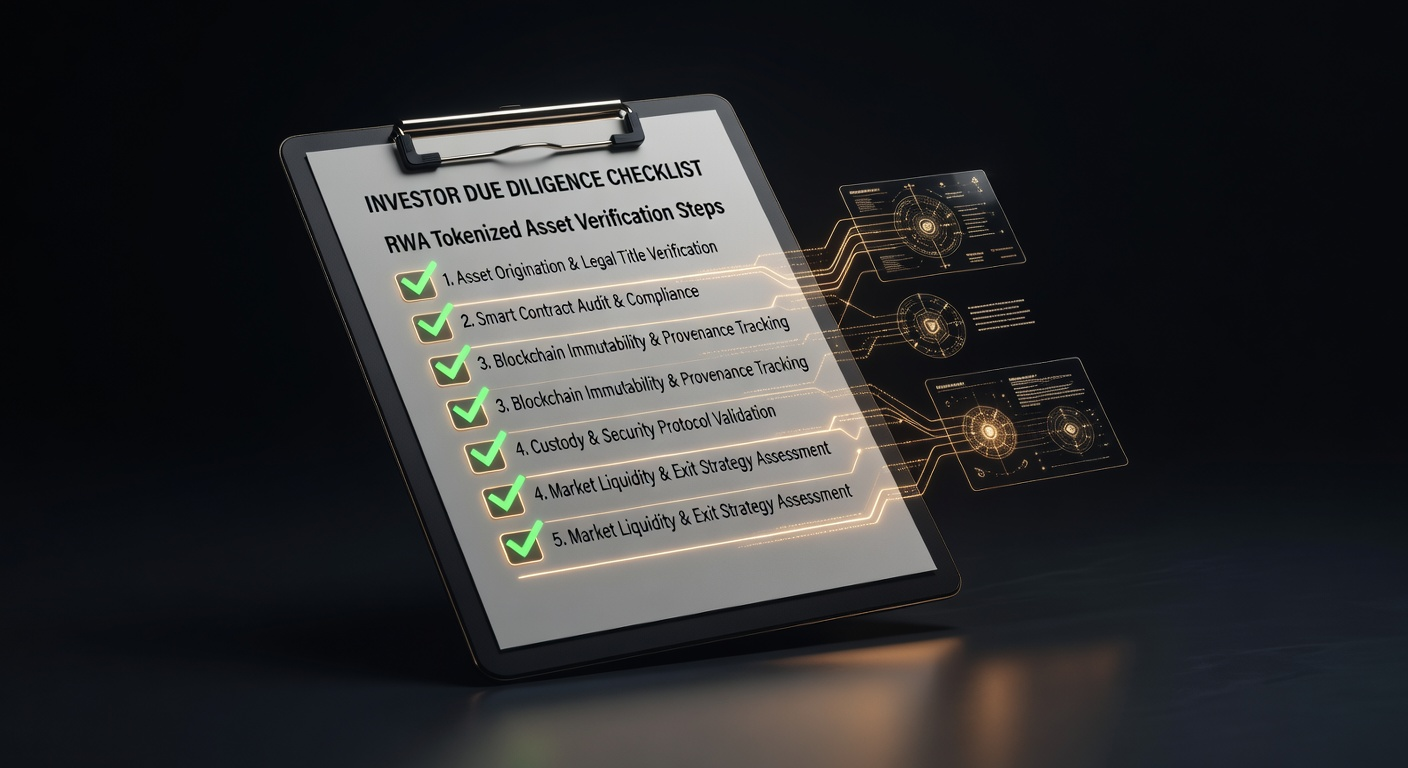
RWA Token Due Diligence: What Sophisticated Investors Check Before Subscribing
Tokenization makes it easier to issue securities. That means it also makes it easier to issue bad ones. A rigorous due diligence framework — borrowed from institutional private equity practice and adapted for on-chain instruments — is the investor's primary defense.
This article is for informational purposes only and does not constitute financial, legal, or investment advice.
Why Standard Crypto Due Diligence Fails for RWA
Most cryptocurrency due diligence focuses on technology risk: Is the protocol audited? Is the team doxxed? Is the tokenomics inflation schedule reasonable? These are valid questions for native crypto assets. They are insufficient for real-world asset tokens.
An RWA token's value is derived not from a protocol's utility or market demand, but from the cash flows and ownership rights attached to a specific physical or financial asset. The relevant risks are not smart contract risks — they are real estate market risks, credit risks, operational risks, legal structural risks, and issuer management risks. The due diligence framework must match the actual risk profile.
Layer 1: Legal Structure
The first thing to understand about any RWA token is what legal claim it actually represents. "Tokenized real estate" is not a legal category. What matters is whether the token represents:
- Membership interest in an LLC that owns property
- A beneficial interest in a trust
- A note or debt obligation
- A revenue-sharing agreement
- Something else entirely
Each of these structures has different bankruptcy treatment, different tax treatment, different governance rights, and different enforcement mechanisms if the issuer defaults.
Questions to Answer
- Is the offering document a Private Placement Memorandum (PPM) or a Term Sheet? A PPM is comprehensive; a term sheet is not sufficient
- Who is the legal entity that issued the token, and is it validly formed in the stated jurisdiction?
- What SEC exemption was used, and has a Form D been filed? (Searchable at sec.gov/cgi-bin/browse-edgar)
- If real estate: Is the property deeded to the SPE, or is there a signed agreement to convey?
- Who is the registered agent, and is the entity in good standing?
- What are the investor's rights if the sponsor becomes insolvent or incapacitated?
"Read the operating agreement, not the pitch deck. The pitch deck is marketing. The operating agreement is the contract. If you can't find the operating agreement, there is nothing to invest in."
Layer 2: Issuer Credibility
Real-world asset tokens require trusting the issuer to manage the underlying asset competently and honestly over a multi-year period. This is a fundamentally different trust requirement than holding a cryptocurrency, where the protocol is trustless by design.
Track Record
- Has this issuer successfully managed similar assets before?
- Have they previously raised capital under securities exemptions?
- Are there existing investors in prior offerings who can speak to their experience?
- Has the issuer ever had an SEC enforcement action, bankruptcy, or significant litigation? (Check PACER, SEC EDGAR, and state securities regulators)
Team Assessment
- Are the principals' identities verifiable through LinkedIn, public records, and professional licenses?
- Does the team have relevant domain expertise (real estate operations, credit underwriting, etc.) beyond blockchain development?
- Are there independent directors or advisory board members with verifiable credentials?
Aligned Incentives
- Does the sponsor have meaningful co-investment (skin in the game)?
- Is the management fee reasonable relative to industry norms?
- Is the promote/carried interest structure aligned with investor returns (e.g., pari passu with investors until preferred return is met)?
Layer 3: Asset Quality
The token is only as good as the asset behind it. For real estate:
Physical and Market Due Diligence
- Has an independent third-party appraisal been conducted within the last 12 months?
- Is there a Phase I Environmental Site Assessment for the property?
- What are comparable properties trading for in the same submarket?
- What is the market vacancy rate for the property type in that location?
- Is there deferred maintenance that will require near-term capital expenditure?
Income Verification
- Are historical rent rolls and operating statements available?
- Are leases long-term (reducing vacancy risk) or short-term (increasing volatility)?
- Have operating expense assumptions been stress-tested at 10% and 20% higher than projected?
- Is property management handled by a qualified third party with contractual obligations?
For Non-Real-Estate RWA
| Asset Type | Key Quality Metrics |
|---|---|
| Private credit/loans | Borrower credit quality, collateral value, LTV ratio, default history |
| Receivables | Counterparty creditworthiness, aging schedule, historical collection rates |
| Commodities | Custodian reputation, storage costs, insurance, commodity market basis |
| Treasury products | Underlying portfolio composition, duration, liquidity terms |
Layer 4: Yield Sustainability
Projected returns in offering documents are marketing. Sustainable returns are what matter for long-term investment success.
Revenue Assumptions Audit
- Is the projected occupancy rate consistent with the local market average?
- Does the rental rate assumption reflect current market rents, or is it aspirational?
- Is revenue growth projected above CPI? If so, what justifies the premium?
Expense Assumption Audit
- Is the management fee realistic for the property type?
- Is there a capital expenditure reserve? How was it sized?
- Are insurance costs based on actual quotes or estimates?
- Does the issuer account for property tax increases in multi-year projections?
Sensitivity Analysis
Any credible offering should include sensitivity analysis showing how investor returns change under stress scenarios. If returns remain strongly positive with 20% lower revenue and 10% higher expenses, the offering has a reasonable margin of safety. If returns go negative with modest stress, the offering is underwriting to perfection.
Layer 5: Exit Rights
The exit section of the operating agreement is where many investors are unpleasantly surprised at the end of a hold period. Read it before you invest.
Forced Exit Provisions
- Is there a defined hold period with a stated exit strategy (sale, refinancing, IPO)?
- Does the operating agreement include a drag-along provision that allows the sponsor to force a sale over minority investor objection?
- If the asset has not been sold at the end of the stated hold period, what happens? Does the sponsor have discretion to extend indefinitely?
Redemption Options
- Is there an issuer redemption program? What are the terms?
- Is redemption at NAV, or at a discount?
- Are there redemption gates (limits on how much can be redeemed per period)?
Secondary Market Reality
- Is the token listed on any secondary market? What is the current bid-ask spread?
- What transfer restrictions apply to secondary sales?
- Has there been any actual secondary market trading volume?
Layer 6: On-Chain Technical Review
For investors with XRPL technical literacy, the token's on-chain configuration provides additional verification data.
- Can you find the issuer's XRPL account on a block explorer and verify its transaction history?
- Does the token's total supply match what was stated in the offering documents?
- Is the transfer fee (if any) consistent with what was disclosed?
- Has the issuer account been configured with appropriate flags (e.g., no unauthorized additional token issuance)?
- Are there escrow objects on the ledger corresponding to disclosed lock-up commitments?
Red Flags That Should Stop Due Diligence
Regardless of how compelling the pitch is, the following items are disqualifying:
- No PPM or subscription agreement — only a term sheet and a whitepaper
- No Form D on file with the SEC for a US-focused offering
- The property or asset has not been conveyed to the SPE at the time of token sale
- The issuer cannot provide a current independent appraisal
- Historical financials show a pattern of late or missed distributions to prior investors
- The team has prior securities enforcement actions or unresolved litigation
- Returns are projected to increase every year without explanation
- There is no disclosed mechanism for investors to exit if the hold period extends
Tokenization is infrastructure, not due diligence. A well-structured RWA token backed by a quality asset, managed by a credible operator, with clear investor rights, is an excellent investment vehicle. The same token mechanics applied to a poorly structured deal with optimistic projections is still a poor investment — just a more technologically novel one.
Issue Tokens on XRPL
OnrampDLT provides non-custodial token issuance infrastructure on the XRP Ledger.
Explore OnrampDLT →