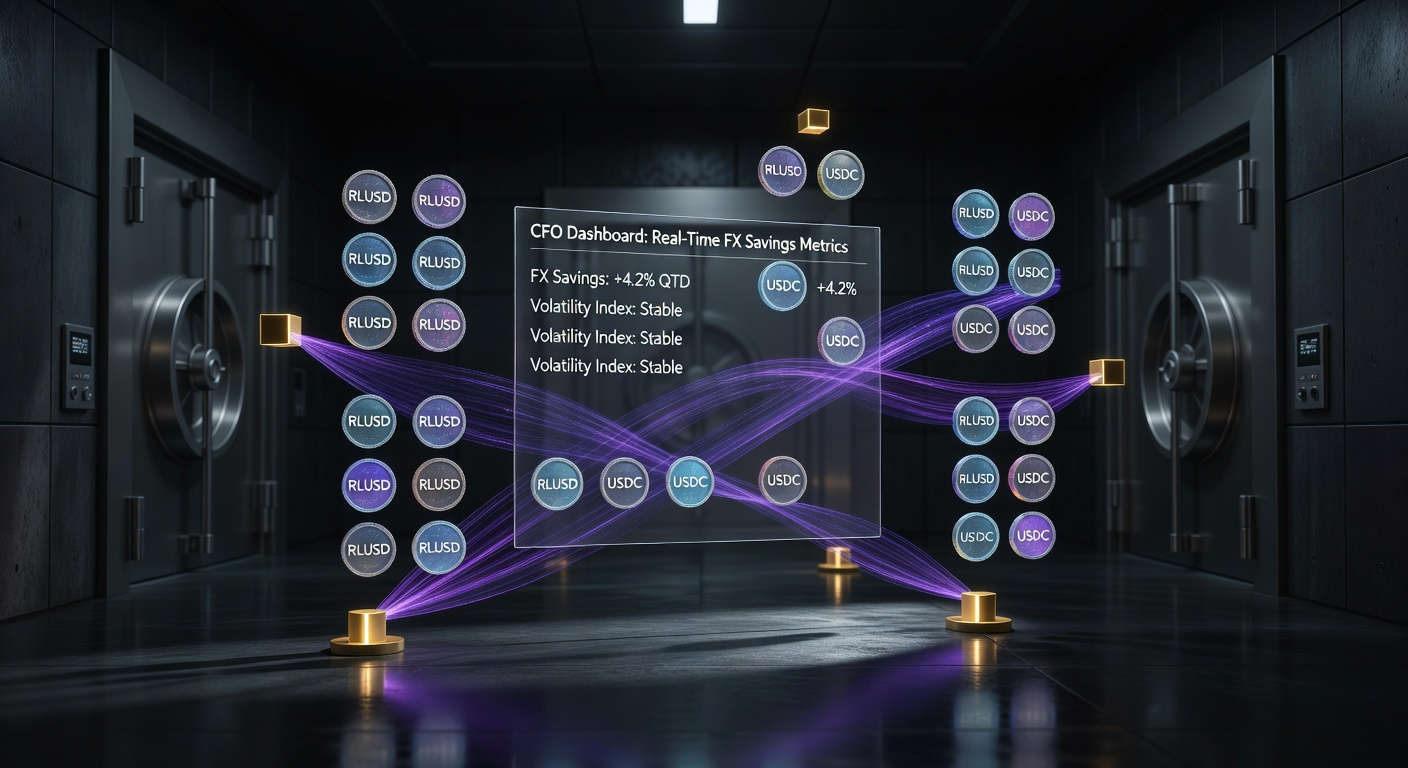
Stablecoin Treasury Management: The Corporate Finance Guide for 2026
Corporate treasury is no longer just about parking idle cash in T-bills. Stablecoins — particularly RLUSD on the XRP Ledger and USDC on multiple chains — are enabling faster supplier payments, reduced FX friction, and yield-generating strategies that traditional banking infrastructure simply can't match.
This article is for informational purposes only and does not constitute financial, legal, or investment advice. Consult a qualified financial professional before implementing treasury strategies involving digital assets.
THE TREASURY CASE FOR STABLECOINS
The word "stablecoin" often triggers two reactions from traditional finance professionals: either skepticism (memories of algorithmic stablecoin collapses) or curiosity about yield. Neither fully captures what well-regulated stablecoins actually offer a corporate treasury department in 2026.
The core value proposition is not about yield. It's about settlement infrastructure. When a company needs to pay a supplier in the Philippines, remit contractor fees to someone in Brazil, or hold short-term liquidity in a currency-stable form for deployment to multiple jurisdictions simultaneously — stablecoins on programmable ledgers like XRPL reduce friction in ways that SWIFT wires and ACH transfers structurally cannot.
The stablecoin market has matured considerably. As of early 2026:
- USDT (Tether): ~$140 billion market cap — dominant by volume, used heavily in emerging market corridors, audited quarterly by BDO
- USDC (Circle): ~$45 billion market cap — regulated, monthly attestations by Deloitte, increasingly preferred by U.S. institutions
- RLUSD (Ripple): $1.3+ billion market cap — launched December 2024, BNY Mellon as primary custodian, approved by NYDFS
- PYUSD (PayPal): ~$800 million market cap — backed by PayPal's distribution network, gaining traction with U.S. merchants
For treasury departments, the relevant differentiators are regulatory standing, custodian quality, redemption speed, and integration with existing financial infrastructure.
USE CASE 1: CROSS-BORDER SUPPLIER PAYMENTS
The most immediate treasury application is replacing international wires for recurring supplier payments. Consider a U.S.-based company with manufacturing in Vietnam and a logistics partner in Singapore. Traditional wire process:
- Initiate wire through U.S. correspondent bank
- Payment routes through USD clearing house, then regional correspondent
- Arrival: 2–4 business days, $25–$50 per wire fee, 1–3% FX spread absorbed somewhere in the chain
- Supplier receives funds and must wait additional days for clearing in local currency
Stablecoin alternative (using USDC or RLUSD on XRPL):
- Treasury transfers USDC/RLUSD to supplier's wallet address
- Transaction confirms on-ledger in 3–5 seconds (XRPL) or minutes (Ethereum)
- Supplier receives funds immediately in USD-equivalent value
- Supplier converts to local currency via any exchange that supports the stablecoin
For suppliers operating in countries where USD is accepted for B2B settlement or where stablecoin-to-local-currency conversion is straightforward (much of Southeast Asia, Latin America, parts of Africa), this is a material improvement in working capital for both parties.
USE CASE 2: MULTI-JURISDICTION LIQUIDITY MANAGEMENT
A common treasury challenge for mid-size multinationals is maintaining liquidity in multiple currencies simultaneously. Maintaining separate banking relationships, accounts, and FX hedges in 8 jurisdictions is administratively intensive and capital-inefficient.
A stablecoin-first liquidity strategy consolidates this: maintain a primary position in a USD stablecoin, and convert to local currency at the point of need rather than maintaining pre-funded local accounts. This mirrors the ODL model used by financial institutions but applied at the corporate treasury level.
The risk is FX timing: if a company needs to pay a euro-denominated invoice, they convert USDC to EUR at spot rate at time of payment. If USD/EUR has moved unfavorably, they absorb that exposure. This is not different from traditional spot FX conversion — but it eliminates the need for pre-funded EUR bank accounts.
USE CASE 3: YIELD ON IDLE CASH
This is where treasury teams need to be most careful — and most specific about what they're doing. Several options exist:
Option A: Tokenized Treasury Bills (T-bills)
BlackRock's BUIDL fund, Franklin Templeton's BENJI, and Ondo Finance's OUSG all offer tokenized short-duration U.S. Treasury exposure. These are regulated investment products, not stablecoins, that settle on blockchain rails. They pay approximately the prevailing T-bill rate (in the 4–5% range as of early 2026, depending on Fed rate environment) and can be transferred on-chain without the T+1 or T+2 settlement delay of traditional money market funds.
For a treasury department already using stablecoin infrastructure, parking idle USD in a tokenized T-bill fund is operationally cleaner than moving funds back to traditional banking systems for yield.
Option B: Stablecoin Lending Protocols
DeFi lending protocols (Aave, Compound, and institutional equivalents like Maple Finance) allow stablecoin holders to earn yield by supplying liquidity to borrowers. Rates fluctuate based on borrowing demand. This carries smart contract risk and counterparty risk that traditional T-bill investments don't — appropriate due diligence is required before deploying treasury capital here.
Option C: Centralized Yield Products
Several centralized platforms offer yield on USDC or USDT holdings. These typically involve the platform lending the assets to institutional borrowers and passing through interest. Risks include platform insolvency (as demonstrated by Celsius and BlockFi collapses in 2022) — treasury teams should treat these as unsecured creditor relationships, not bank deposits.
For most corporate treasury departments in 2026, tokenized T-bills are the appropriate yield vehicle — the returns are comparable to money market funds, the underlying assets are as safe as they get, and the on-chain settlement speed is a genuine operational improvement.
RLUSD'S SPECIFIC ADVANTAGES FOR INSTITUTIONAL TREASURY
RLUSD was designed explicitly for institutional use, and its architecture reflects that. Key differences from other stablecoins that matter for treasury departments:
- NYDFS approval: Issued under New York's BitLicense framework, giving U.S.-regulated institutions clear compliance footing
- BNY Mellon custody: The underlying dollar reserves are custodied at BNY Mellon — the same bank used by many institutional funds for USD custody
- XRPL native: Issued on the XRP Ledger, enabling same-ledger settlement with XRP and instant atomic swaps on the XRPL DEX
- Ethereum bridge: RLUSD is also available on Ethereum, enabling use across DeFi infrastructure
- SBI distribution: SBI Holdings is distributing RLUSD in Japan, providing institutional on-ramp in one of the largest FX markets globally
For a treasury department already using XRPL infrastructure for supplier payments, RLUSD provides a consistent settlement asset that doesn't introduce XRP price exposure — useful when the payment needs to arrive in USD-equivalent value and the treasury team isn't comfortable with XRP's volatility as a transient bridge asset.
COMPLIANCE AND ACCOUNTING CONSIDERATIONS
Holding stablecoins on corporate balance sheets triggers several accounting and compliance questions that treasury teams need to address before implementation:
Financial Reporting
Under U.S. GAAP (ASC 350), digital assets held on balance sheet are typically classified as indefinite-lived intangible assets and tested for impairment. The FASB issued ASU 2023-08 in December 2023, effective for fiscal years beginning after December 15, 2024, requiring fair value measurement for certain crypto assets with changes recognized in net income. Stablecoins that maintain a consistent $1 value are less affected, but treatment varies — consult your auditor.
Tax Treatment
In the United States, each disposal of a stablecoin (spending, converting, transferring in exchange for services) is technically a taxable event. If the stablecoin maintains a stable $1 value, gains/losses are minimal — but meticulous records of acquisition cost and disposal price are required. Treasury teams using stablecoins at any scale should integrate crypto accounting software (Cointracker, Cryptio, or enterprise solutions) with their ERP systems.
Bank Secrecy Act / AML
Companies using stablecoins for payments are not automatically money transmitters — but if you are aggregating and dispersing stablecoin payments for third parties, FinCEN registration may apply. Using regulated, NYDFS-approved stablecoins (RLUSD, USDC) with clear on-chain provenance is the compliance-preferred approach for any institutional treasury program.
BUILDING A STABLECOIN TREASURY POLICY
Treasury departments considering stablecoin integration should establish a formal policy covering:
- Approved assets: Define which stablecoins are approved (typically USDC, RLUSD, USDT — with USDC/RLUSD preferred for regulated entities)
- Maximum position limits: Cap the percentage of total treasury that can be held in stablecoins vs. traditional cash equivalents
- Custody standards: Define which custody solutions are approved — institutional custodians (Coinbase Custody, Fireblocks, Anchorage Digital) vs. self-custody wallets
- Use cases: Specify which payment corridors or use cases are approved for stablecoin settlement
- Reporting frequency: Daily or real-time position reporting to integrate with overall cash management
Stablecoin treasury is not a wholesale replacement of traditional banking relationships. It's a complement — filling the gaps where traditional banking is slow, expensive, or unavailable. The treasury teams that will benefit most in 2026 are those that identify two or three specific pain points (typically: a high-cost remittance corridor, idle international cash, or slow B2B settlement) and implement stablecoin solutions for those specific use cases before expanding further.
Issue and Manage Tokens on XRPL
OnrampDLT provides the infrastructure for institutional teams to issue, manage, and settle tokenized assets on the XRP Ledger.
Explore OnrampDLT →