Tokenized T-Bills: How Institutions Are Bringing $25T in Treasuries On-Chain
BlackRock, Franklin Templeton, and a growing list of asset managers are tokenizing US Treasury securities. The products work, the yields are real, and the implications for DeFi collateral and on-chain capital markets are profound.
This article is for informational purposes only and does not constitute financial, legal, or investment advice.
Why Treasuries First?
Among all the real-world assets being tokenized — real estate, commodities, private credit, art — US Treasury securities have emerged as the first major institutional success story. The reason is not complicated: Treasuries are the most liquid, most standardized, and most creditworthy financial instruments in the world. They make an ideal initial product for institutions entering the tokenization space because the underlying asset risk is minimal and well-understood.
US Treasury market outstanding exceeds $25 trillion. Even a small percentage on-chain represents a massive opportunity. At the time of writing, the tokenized Treasury market has grown to several billion dollars in total value across multiple platforms — a small fraction of the total, but enough to validate the model at institutional scale.
BlackRock BUIDL: The Marquee Product
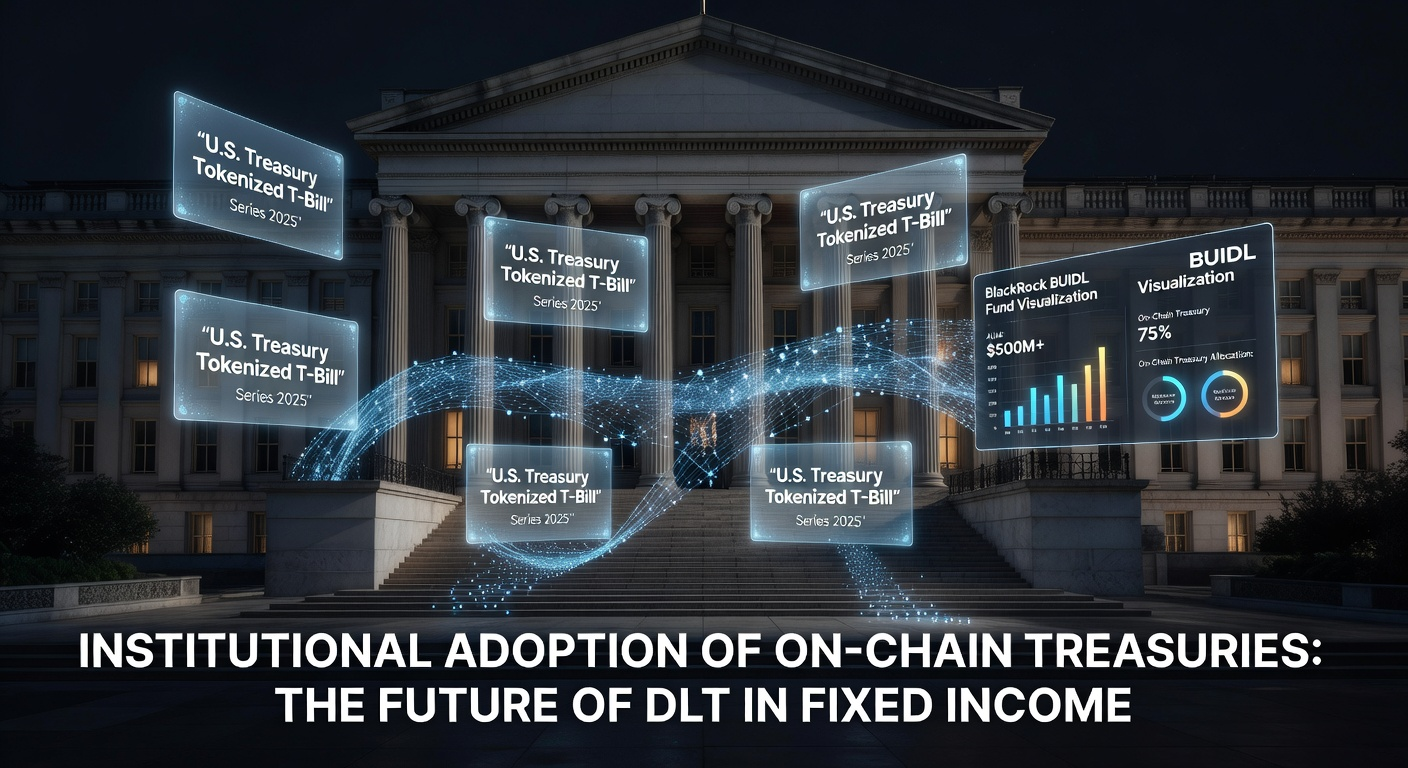
BlackRock launched the BlackRock USD Institutional Digital Liquidity Fund (BUIDL) in March 2024, deploying it on the Ethereum blockchain in partnership with Securitize. BUIDL is a registered investment fund under the Investment Company Act — not a DeFi protocol or a private placement, but a traditional regulated fund with blockchain-based record keeping.
How BUIDL Works
- The fund invests 100% of assets in US Treasury bills, repurchase agreements, and cash
- Fund shares are tokenized on Ethereum as ERC-20 tokens
- Each token represents one dollar of net asset value
- Interest accrues daily and is distributed monthly as new tokens
- Minimum investment: $5 million (institutional only)
- BNY Mellon serves as custodian and administrator
BUIDL rapidly became the largest tokenized Treasury fund by assets under management, attracting significant institutional capital within weeks of launch. It demonstrated that asset managers with BlackRock's scale and credibility were willing to put serious infrastructure behind blockchain-based securities — a signal the market had been waiting for.
Franklin Templeton BENJI: The Pioneer
Franklin Templeton actually predates BlackRock in the tokenized fund space. The Franklin OnChain U.S. Government Money Fund (ticker: BENJI) was registered as a blockchain-based fund in 2021 and initially deployed on the Stellar network before expanding to other chains.
BENJI is a money market fund investing in US government securities and repurchase agreements. What makes it notable is that the fund's shareholder records are maintained on-chain as the official record of truth — not a shadow record, but the actual register. This is a more fundamental commitment to blockchain infrastructure than simply tokenizing secondary records.
Franklin Templeton has been among the most progressive major asset managers on blockchain infrastructure, consistently deploying on multiple networks and exploring interoperability between chains. BENJI represents a multi-year commitment to the thesis that blockchain is viable for regulated fund administration.
How Yield Mechanics Work
Understanding how tokenized Treasury funds generate and distribute yield clarifies both the investment proposition and the technical plumbing.
Yield Generation
The fund holds actual Treasury securities — bills, notes, or repo agreements with Treasury collateral. These instruments pay interest. At current Fed Funds rate levels, a short-duration Treasury fund earns somewhere between 4% and 5% annually depending on the rate environment (this fluctuates with Fed policy).
Yield Distribution Options
There are two primary models for distributing yield in tokenized Treasury products:
- Rebasing (token quantity grows) — Each holder's token balance increases daily to reflect accrued interest. The token price remains $1.00; the number of tokens grows. This approach is simple for holders to understand and integrates well with DeFi protocols that need a stable $1.00 price
- Accumulation (token price grows) — The token quantity remains constant, but the NAV per token increases as interest accrues. This is more analogous to a traditional fund structure and may have different tax treatment
BUIDL uses a monthly distribution model — interest accrues daily and is paid as new tokens at month end. BENJI maintains a $1.00 per share target with distributions paid monthly.
| Product | Issuer | Chain | Yield Type | Min Investment |
|---|---|---|---|---|
| BUIDL | BlackRock / Securitize | Ethereum | Monthly distribution | $5,000,000 |
| BENJI | Franklin Templeton | Multi-chain | Monthly distribution | $20 |
| USYC | Hashnote | Multiple | Rebasing | Institutional |
| OUSG | Ondo Finance | Multiple | Rebasing | $5,000 |
DeFi Collateral: The Killer Application
The most transformative use case for tokenized Treasuries is not simply "holding yield-bearing cash on-chain." It's using tokenized Treasuries as DeFi collateral.
In traditional DeFi, the primary collateral assets are volatile cryptocurrencies. Borrowing against ETH or BTC requires massive overcollateralization because the collateral can drop 50% overnight. Tokenized Treasuries as collateral changes the calculus entirely — a $1.00 Treasury token that earns 4% yield can serve as near-perfect collateral for stablecoin borrowing, swap margining, or credit facilities.
This is where tokenized Treasuries potentially reshape the capital efficiency of on-chain finance. Instead of holding idle stablecoins that earn nothing, DeFi protocols and DAOs can hold Treasury tokens that earn 4–5% yield while simultaneously available as collateral. The "idle capital" problem in DeFi treasuries — which historically totaled billions in zero-yielding stablecoins — is being directly addressed by these products.
"When BUIDL launched, MakerDAO integrated it as collateral for DAI. That's the moment tokenized Treasuries became structurally important to DeFi — not just a product for institutions, but the yield-bearing base layer for all of on-chain finance."
Regulatory Structure and Investor Eligibility
Most institutional tokenized Treasury products are registered investment funds or offered under securities exemptions. BUIDL, as a registered fund, requires investors to complete standard fund subscription and KYC procedures. BENJI's retail availability (minimum $20) is possible because Franklin Templeton registered it with the SEC as a traditional money market fund — the blockchain is an operational choice, not a regulatory escape hatch.
For issuers outside the major asset manager tier who want to create similar products, the path typically involves:
- Creating a fund vehicle (limited partnership or trust) that holds Treasuries
- Registering the fund or qualifying for an exemption (Reg D for accredited investors)
- Tokenizing fund shares on an appropriate blockchain
- Engaging a qualified custodian for the underlying Treasuries
XRPL's Position in Tokenized Treasuries
Most of the high-profile tokenized Treasury products launched first on Ethereum, Stellar, or proprietary chains. XRPL has not yet been the primary deployment chain for major institutional Treasury products — primarily because the major issuers have existing relationships with Ethereum ecosystem infrastructure providers.
However, the technical requirements for a tokenized Treasury on XRPL are fully met by the existing infrastructure. XRPL's issued currency system, trust line framework, transfer fee mechanism, and DEX/AMM liquidity all support exactly the kind of product BUIDL and BENJI have deployed elsewhere. And XRPL's cost structure — $0.0002 per transaction — is more favorable than Ethereum for high-frequency small distributions.
As XRPL's institutional ecosystem matures and as multi-chain deployment becomes standard practice for tokenized asset managers, XRPL is a natural candidate for Treasury product deployment. The infrastructure is ready; the institutional partnerships are the limiting factor.
Issue Tokens on XRPL
OnrampDLT provides non-custodial token issuance infrastructure on the XRP Ledger.
Explore OnrampDLT →