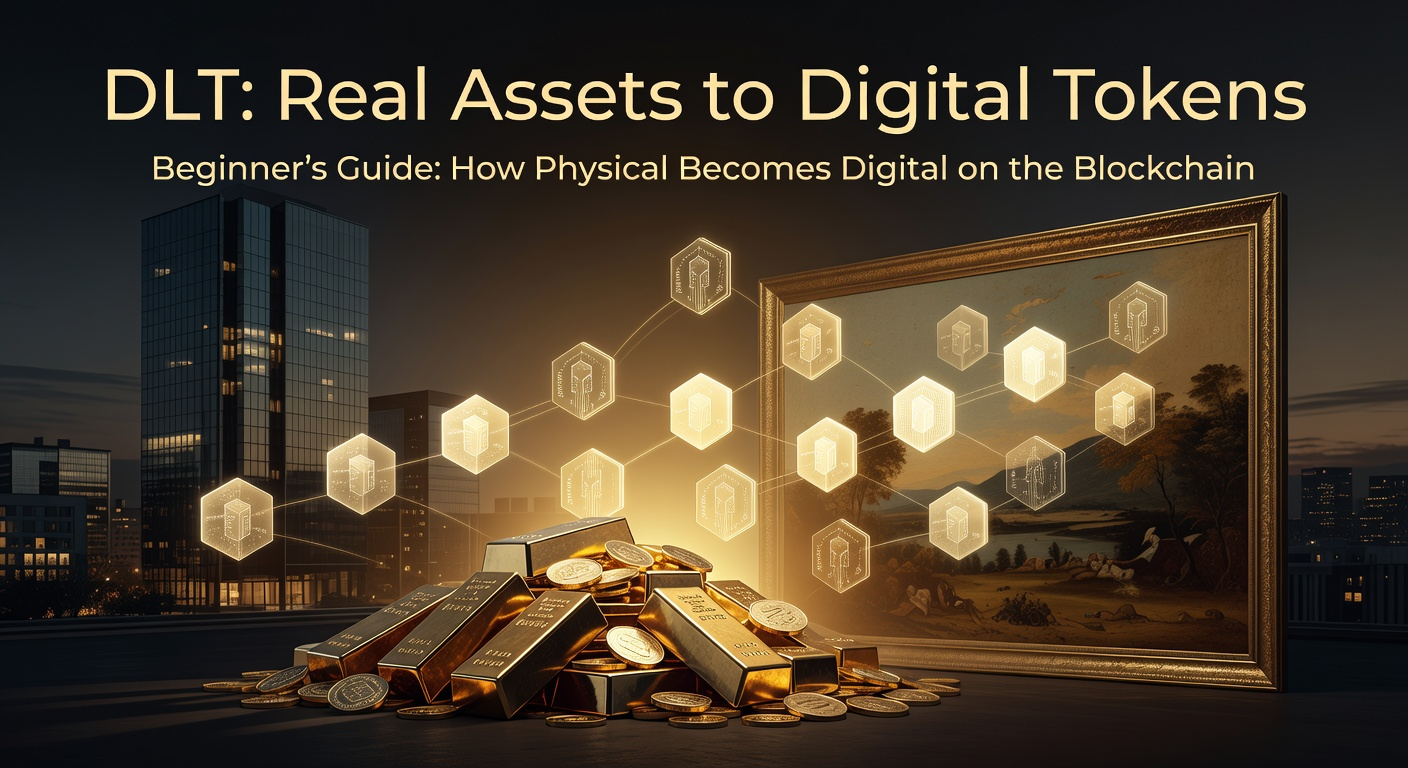
What Is Real-World Asset Tokenization? The Infrastructure Perspective
BCG projects $16 trillion in tokenized assets by 2030. Some projections reach far higher by the early 2030s. The market is currently under $2 trillion. What's happening, why it matters, and why the XRP Ledger is positioned at the center of this shift.
Real-world asset (RWA) tokenization is the process of representing ownership rights in a physical or financial asset as a digital token on a distributed ledger. The token doesn't contain the asset — it contains a cryptographically verifiable claim of ownership, enforced by the ledger's consensus mechanism and backed by off-chain legal agreements.
That's the technical definition. The economic significance is larger: an estimated $500 trillion in global illiquid assets — real estate, private equity, commodities, art, infrastructure — has historically been accessible only to institutions and high-net-worth individuals. Tokenization changes the access model, the liquidity profile, and the settlement mechanics simultaneously.
The Problem That Tokenization Solves
Traditional asset ownership has four structural deficiencies that tokenization directly addresses:
1. Artificial Minimum Investment Size
A $5 million commercial building cannot be purchased in $100 increments. The minimum investment is the full purchase price or a large syndication minimum ($50,000–$100,000). This has nothing to do with the asset's fundamental divisibility — it's a function of the legal and operational overhead required to divide ownership through traditional structures. Tokenization eliminates that overhead, enabling any division of ownership that markets can support.
2. Settlement Latency
Traditional securities settle T+1 or T+2 under optimistic conditions. Real estate transfers take weeks. Private equity interests transfer over months. XRPL settlement finalizes in 3–5 seconds with absolute finality — no reorg risk, no counterparty credit exposure during settlement. The gap between trade and settlement is where systemic risk accumulates in traditional finance. Tokenized assets on XRPL have no gap.
3. Opacity in Ownership Records
County recorder offices, share registries, and title companies hold ownership records in siloed databases with varying accessibility and update latency. Blockchain-based ownership records are public, continuously updated, immutably timestamped, and accessible to any party globally without intermediary permission. For regulated assets, this transparency also enables real-time compliance monitoring that traditional registries cannot provide.
4. Liquidity Discount
Illiquid assets trade at a discount to comparable liquid assets. The liquidity premium is real and quantifiable. An apartment building that takes 3 months to sell is worth less per dollar of cash flow than an equivalent REIT share that trades continuously. Tokenization, by enabling secondary market trading in any size increment, narrows or eliminates this discount — directly increasing the asset's value to its owner.
What "Tokenization" Actually Means Operationally
Three things happen simultaneously in an RWA tokenization:
- Legal structuring: An LLC, SPV, or trust is formed to hold the underlying asset. The token represents ownership of an interest in this legal entity — not a direct claim on the physical asset itself. This is the layer that makes tokenization enforceable in real-world courts.
- On-chain token creation: Tokens representing the ownership interests are issued on a ledger. The ledger records who holds what, enforces transfer rules (including compliance restrictions), and settles transfers in real time.
- Economic synchronization: Income from the underlying asset (rent, dividends, royalties) is distributed to token holders, typically by sending stablecoin payments to all holder addresses. Governance rights, voting, and corporate actions are coordinated through on-chain mechanisms or off-chain legal processes aligned with on-chain holdings.
Why XRPL's Architecture Fits This Use Case Specifically
The XRP Ledger was not designed as a general-purpose smart contract platform. It was designed for payments and asset issuance at institutional scale. That constraint produces a feature set that maps precisely onto RWA tokenization requirements:
| RWA Requirement | XRPL Native Feature |
|---|---|
| KYC/AML holder gating | RequireAuth — only authorized trust lines can receive tokens |
| Regulatory freeze capability | GlobalFreeze — pause all token transfers instantly |
| Court-ordered asset recovery | Clawback — retrieve tokens from any wallet when enabled |
| Distribution cost at scale | ~$0.0002 per transfer — 1,000 holder payments costs $0.20 |
| Secondary market liquidity | Native DEX — tokens tradeable against any XRPL asset immediately |
| Absolute settlement finality | BFT consensus — validated ledger is final, no reorg risk |
| ESG compliance for institutions | ~0.0079 kWh per transaction — near-zero carbon footprint |
Asset Classes in Active Tokenization
Real Estate
The largest and most active RWA tokenization segment. Residential and commercial properties have been tokenized on XRPL and other ledgers, providing fractional ownership, automated rental distributions, and secondary market liquidity. St. Regis Aspen completed an $18M tokenized resort offering. RealT and Lofty are tokenizing residential properties at volume.
Treasury Securities and Money Market Funds
The fastest-growing segment in 2025–2026. BlackRock BUIDL, Franklin OnChain US Government Money Fund, and similar products bring institutional-grade yield into on-chain portfolios. These are effectively tokenized cash equivalents — widely used as collateral in on-chain credit markets.
Private Credit and Debt Instruments
Tokenized bonds, promissory notes, invoice receivables, and commercial loans. These instruments bring secondary market liquidity to traditionally illiquid debt positions and enable fractionalization that opens them to a broader investor base.
Commodities
Paxos Gold (PAXG) tokenizes London Good Delivery gold bars. Each token represents one troy ounce with the physical gold stored in Brinks vaults. Similar models exist for silver, oil, and agricultural commodities — combining the price exposure of physical commodity ownership with the liquidity and divisibility of on-chain assets.
The Regulatory Layer: Non-Negotiable
For any asset that generates returns for investors, the Howey Test is the relevant analytical framework. If a token satisfies all four prongs — investment of money, in a common enterprise, with expectation of profit, from the efforts of others — it is a security under US law, regardless of how it's labeled.
Most RWA tokens are securities. The regulatory path for US-based offerings typically runs through Regulation D (Rule 506(b) or 506(c)), which permits capital raises from accredited investors without full SEC registration. Non-accredited investor access requires Regulation A+ (up to $75M) or Regulation CF (up to $5M via registered crowdfunding platforms).
XRPL's native compliance features — RequireAuth for accredited investor gating, freeze capability for regulatory actions — make it operationally easier to maintain these compliance requirements than platforms that require custom smart contract code for equivalent functionality.
The Market Position
Tokenization is not a speculative technology thesis. It is capital markets infrastructure that the world's largest institutions are actively building. The question for participants today is not whether it will happen — it's whether your position will be built before or after the transition accelerates.
The infrastructure that handles the first $2 trillion in tokenized assets will handle the next $20 trillion. The protocol rails being established now are the rails institutional capital will flow through for decades.
Issue Your First RWA Token
OnRampDLT is the token issuance platform for XRPL — with built-in compliance controls, trust line management, and holder distribution. Start on testnet for free.
Launch Your Token →