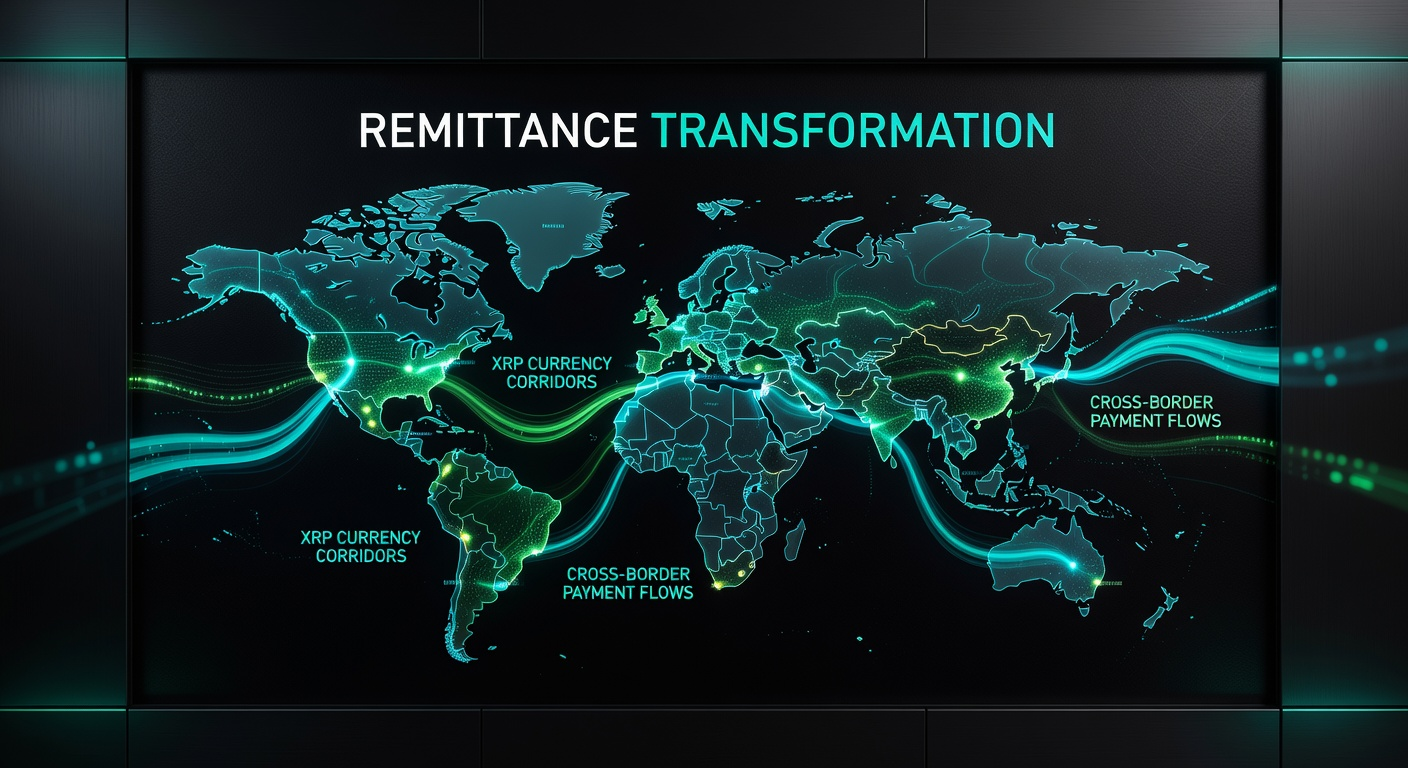
XRP Cross-Border Payments: How ODL Is Replacing SWIFT
SWIFT is 50 years old. Correspondent banking is a relic of an era before internet-native settlement was possible. Ripple's ODL network — running on XRPL — settled an estimated $500M–$1B per month in 2025 and is accelerating. Here's the mechanics.
Why Correspondent Banking Is the Problem
When your bank sends money internationally, it almost never goes directly. The payment travels through a series of correspondent bank relationships — intermediaries who maintain accounts in multiple currencies and coordinate the hop-by-hop transfer. Your US bank sends to a correspondent with a European relationship, which sends to a correspondent with a relationship in the destination country, which finally credits the recipient's local bank.
Each hop takes 1–3 business days. Each hop costs $10–$25. The exchange rates applied at each conversion point include spreads the banks don't disclose. The total cost for a $500 remittance to the Philippines via traditional banking: approximately $32–$35, or 6.5–7%. The total time: 3–5 business days, not counting weekends and local holidays.
The correspondent banking system was designed when international wire transfer required teletype messages and physical currency movement. SWIFT — the messaging protocol it runs on — was launched in 1973. The system is not broken; it was never designed for the settlement speeds that technology now makes possible.
The deeper problem: $27 trillion sits in nostro/vostro accounts at correspondent banks around the world — capital that banks must pre-position in foreign currencies to facilitate correspondent relationships. That capital earns minimal returns while it waits. The liquidity cost is paid by consumers and businesses through the fees charged on international transfers.
The XRP Bridge: How ODL Works
Ripple's On-Demand Liquidity (ODL) product eliminates the need for pre-positioned capital by using XRP as a bridge currency that converts instantly at each end of the transaction.
The sequence:
- Sender's institution converts USD to XRP on a regulated exchange (Bitstamp, Bitso, etc.)
- XRP is transferred on the XRP Ledger — 3–5 seconds, $0.0002 fee, absolute finality
- Recipient's institution immediately converts XRP to local currency (PHP, MXN, THB) on a local regulated exchange
Total corridor time: minutes (limited by exchange conversion latency, not settlement). Total cost: exchange spreads at each end, approximately 0.5–1.5%. No pre-positioned capital required. No multi-day clearing window. No correspondent bank fees.
Who Is Using ODL Now
MoneyGram
One of the world's two largest remittance companies integrated ODL in 2019. Key corridors: US-to-Philippines, US-to-Mexico, US-to-Europe. The integration reduced their working capital requirements in those corridors significantly and enabled tighter FX spreads for customers. Settlement that previously took 24–48 hours now completes in minutes.
SBI Remit (Japan)
SBI Holdings' remittance arm serves the Japan-to-Southeast-Asia corridor, dominated by Filipino workers in Japan sending money home. ODL enables real-time settlement with exchange rates that compete directly with traditional bank wire transfers. Market share has shifted meaningfully toward SBI Remit from traditional bank wire services in this corridor.
Tranglo (Asia-Pacific)
A payment hub integrated with ODL for cross-border transactions across Asia-Pacific. Serves 100+ markets and 70+ currencies, including corridors (Malaysia-to-Myanmar, for example) where traditional banking infrastructure is thin and correspondent relationships are expensive.
Central Bank Pilots
Bhutan's Royal Monetary Authority and Palau's central bank have both piloted XRPL for CBDC (Central Bank Digital Currency) issuance. If these CBDC implementations scale, they establish XRPL as settlement infrastructure at the sovereign level — a qualitatively different adoption tier than commercial payments.
XRP vs. Stablecoins for Settlement
The obvious question: why not use USDC or USDT instead of XRP? Stablecoins are already widely used for cross-border settlement. What does XRP add?
| Factor | XRP | USDC/USDT |
|---|---|---|
| Settlement finality | 3–5 sec, absolute (XRPL) | Varies by chain (15s+ on Ethereum) |
| Decentralization | No single issuer freeze capability | Centre/Tether can blacklist addresses |
| Currency neutrality | Bridges any currency pair | USD-denominated only |
| Regulatory clarity (US) | Not a security (2025 ruling) | Evolving regulatory framework |
| Liquidity (daily volume) | $30–50B across global exchanges | USDC: ~$7B; USDT: ~$70B |
Stablecoins work well for USD-to-USD or USD-to-stablecoin transfers. XRP's advantage is currency-pair agnosticism: it can bridge USD to PHP to THB to MXN to EUR without requiring a USD-denominated stablecoin as an intermediate step. For truly multi-currency corridors, the absence of a USD-anchor requirement is operationally significant.
The Liquidity Question
Skeptics ask: if ODL volume scaled significantly, would XRP liquidity support it without large price impact? The current numbers:
- XRP daily trading volume: $30–50B across all exchanges
- SWIFT daily settlement volume: $5–6 trillion
- Current ODL volume: estimated $500M–$1B monthly
Even at 100x current ODL volume, the flows would represent a small fraction of XRP's daily liquidity. The real constraint is not XRP liquidity — it's local currency liquidity on exchanges in specific corridors (XRP/PHP pairs in Manila, XRP/MXN pairs in Mexico City). That liquidity builds organically as corridor volume grows and market makers allocate capital where spreads justify it. XRPL's native DEX provides an additional liquidity layer through its auto-bridging mechanism.
The RLUSD Integration Angle
With RLUSD now live on XRPL and passing $1.3B market cap, a new pattern is emerging: ODL using RLUSD at the source end. A US institution converts USD to RLUSD on XRPL (near-zero cost), transfers it to the destination institution, which converts from RLUSD to local currency at the destination exchange. This eliminates the source-side XRP conversion entirely — useful in corridors where RLUSD has better liquidity on local exchanges than XRP.
The XRPL's native DEX handles the RLUSD-to-XRP-to-local-currency path automatically through auto-bridging when direct RLUSD/local-currency pairs are illiquid. The infrastructure flexibility is a function of the protocol design, not external protocol composition.
Build Payment Infrastructure on XRPL
OnRampDLT provides the token issuance and payment infrastructure for businesses building on the XRP Ledger. From RLUSD settlement to on-chain payment verification — the tools are available now.
Explore the Platform →