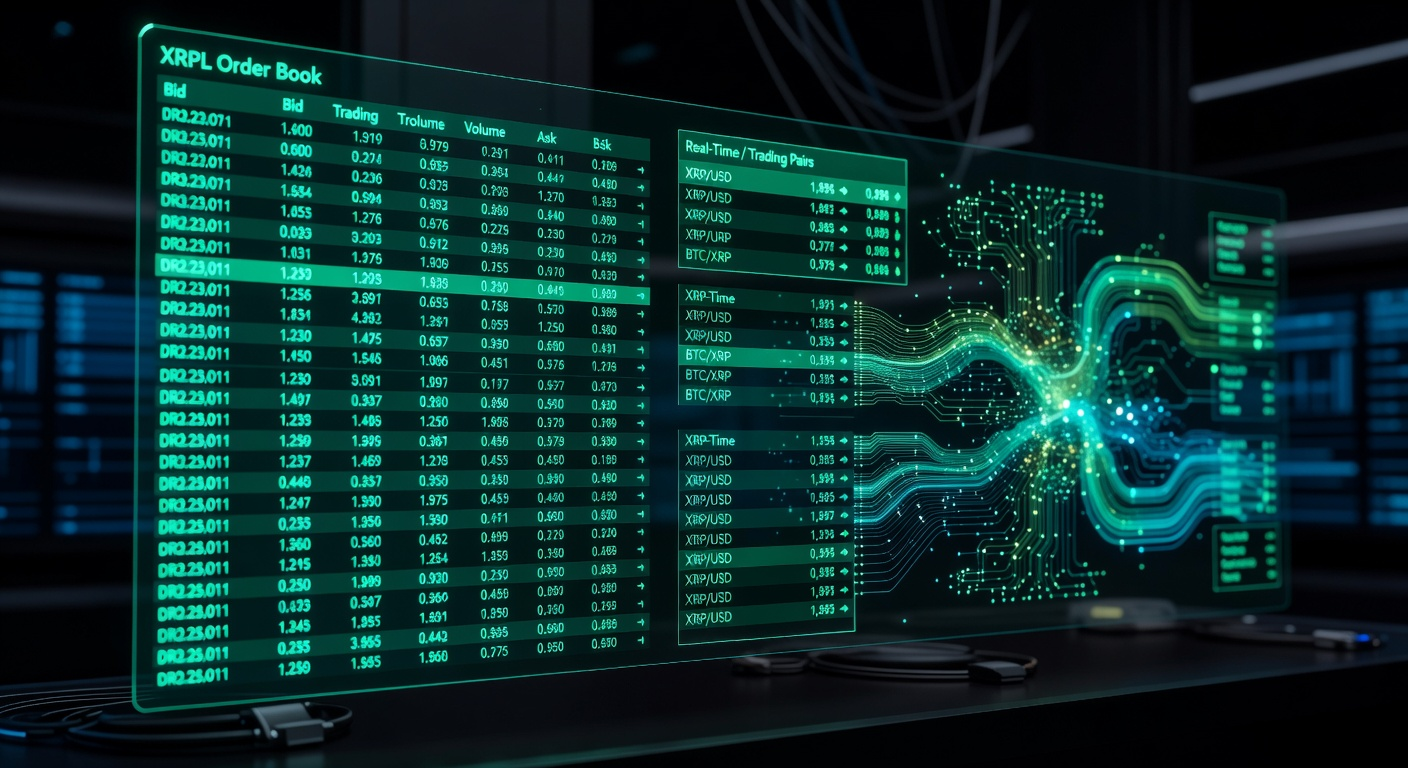
The XRPL DEX: On-Chain Order Books Before DeFi Was a Word
Long before Uniswap, Compound, or the word "DeFi" entered the lexicon, the XRP Ledger was running a fully on-chain decentralized exchange with limit orders, pathfinding, and auto-bridging through XRP. It is one of blockchain's most underappreciated achievements.
This article is for informational purposes only and does not constitute financial, legal, or investment advice.
A DEX Before DeFi Had a Name
The XRP Ledger launched in 2012 with a built-in decentralized exchange. Not a protocol layered on top of a general-purpose blockchain. Not a set of smart contracts deployed by a team. A DEX baked into the ledger's consensus rules from day one.
At the time, Bitcoin was the only significant blockchain in existence and its scripting system was deliberately limited. The concept of a decentralized exchange was barely theoretical. Yet XRPL's developers — working at what would become Ripple — built a fully functional on-chain order book exchange as a core protocol feature.
It would be six more years before Uniswap launched on Ethereum. By then, the XRPL DEX had been processing live trades for half a decade.
How the Order Book Works
The XRPL DEX is a central limit order book (CLOB), not an automated market maker. Traders post limit offers specifying the currency they want to pay, the amount, the currency they want to receive, and the quantity. These offers sit on the ledger, consuming a small XRP reserve, until they are matched, cancelled, or expire.
Matching happens deterministically during transaction processing. When a new offer is submitted, the ledger checks for existing offers on the opposite side of the book that are at equal or better prices. If matches exist, they are executed atomically — both sides of the trade complete in a single ledger close.
Partial fills are supported. If an incoming offer is larger than the best available match, the remainder of the offer stays on the book as a new standing order. This is standard CLOB behavior, and it means XRPL supports sophisticated trading strategies: limit orders, partial fills, and time-in-force logic through the offer expiration field.
Pathfinding: The Hidden Superpower
XRPL's most technically sophisticated feature is its pathfinding engine. A payment from Currency A to Currency C does not require a direct A/C order book to exist. The pathfinder searches for sequences of order books that connect the source and destination currencies, routing through intermediate assets.
Example: EUR to CNY via XRP
- Sender holds EUR (issued by a gateway)
- There is a liquid EUR/XRP order book
- There is a liquid XRP/CNY order book
- There is no direct EUR/CNY order book
The pathfinder identifies the EUR → XRP → CNY path and executes both legs atomically. The sender sends EUR; the recipient receives CNY. Neither party needs to hold XRP; it is used and discarded as a bridge asset in a single transaction. This is the atomic multi-hop payment that underlies Ripple's payment network.
Auto-Bridging
Auto-bridging is a specific optimization where the ledger automatically uses XRP as a bridge when it improves the execution price, even if the trader did not specify a path. This happens transparently during offer matching. A trade between two issued currencies will automatically route through XRP if doing so gives the trader a better rate than the direct book — and the trader doesn't have to know this is happening.
Auto-bridging increases liquidity efficiency across the entire XRPL token ecosystem. Market makers only need to provide liquidity against XRP; the protocol handles the composition of cross-currency paths.
"Auto-bridging means that liquidity added to any XRP pair benefits all XRP pairs. A market maker providing EUR/XRP liquidity is simultaneously improving execution quality for anyone trading EUR against any other XRP-paired asset."
Trust Lines and the Issuer Relationship
Trading on the XRPL DEX requires understanding trust lines. Every issued currency on XRPL is a claim on a specific issuer — not a generic token. EUR issued by Gateway A is a different ledger object from EUR issued by Gateway B, even though both claim to represent euros.
A trust line is a bilateral relationship between a holder and an issuer. Before you can hold or trade an issued currency, you must open a trust line to the issuer, specifying the maximum liability you're willing to accept from that issuer. The trust line costs 2 XRP in reserve.
For traders on the DEX, trust line management is a practical consideration. To trade Token X, you must trust Token X's issuer up to some limit. Most XRPL applications handle trust line setup automatically, but issuers should understand that this is a prerequisite for secondary market trading of their token.
The Offer Object and Market Making
On XRPL, a standing limit order is represented as an Offer object on the ledger. Like all ledger objects, it consumes a 2 XRP owner reserve from the account that created it. This reserve requirement is intentional — it prevents spam by ensuring that standing offers have a meaningful cost.
For market makers, this means managing reserve requirements across potentially many standing orders. A market maker running a simple two-sided market in 10 currency pairs with 5 orders per side would need 100 × 2 = 200 XRP in reserves just to maintain the order book. These reserves are not lost — they are returned when the offer is cancelled or filled — but they must be available.
Passive Offers
XRPL supports passive offers via the tfPassive flag. A passive offer does not immediately consume matching offers from the book — it only sits and waits for the other side. This prevents the taker from being immediately matched and is used by market makers who want to provide liquidity without risking immediate adverse fills.
Performance: Settlement in 3–5 Seconds
The XRPL DEX settles trades with full finality in approximately 3–5 seconds — the ledger close time. Compare this to Ethereum's ~12 second block time with additional confirmation periods required for practical finality. For a DEX, this settlement speed matters for user experience and for applications that need to react to trade outcomes programmatically.
Transaction costs on the XRPL DEX are approximately $0.0002 per transaction (at typical XRP prices and fee levels). This is orders of magnitude cheaper than Ethereum DEX trading, where gas fees can range from a few dollars to tens of dollars depending on network congestion. For high-frequency trading applications and for users making small trades, the cost difference is decisive.
| Metric | XRPL DEX | Uniswap (Ethereum) | Uniswap (Arbitrum) |
|---|---|---|---|
| Settlement time | 3–5 seconds | ~12 seconds + confirms | ~2 seconds |
| Tx cost | ~$0.0002 | $2–$50+ | $0.10–$1.00 |
| Order type | Limit orders (CLOB) | AMM only | AMM only |
| Pathfinding | Native multi-hop | Manual routing | Manual routing |
| Finality | Immediate | Probabilistic | Probabilistic |
DEX + AMM: The 2024 Upgrade
The AMM amendment activated on XRPL in 2024, adding automated market making pools alongside the existing order book DEX. Critically, these two systems are not separate venues — they are unified by the same pathfinding engine. A trade can route through the order book, through an AMM pool, or through a combination of both, whichever produces better execution.
This is architecturally unique. On Ethereum, you choose between Uniswap (AMM) and dYdX (order book) and various other venues. On XRPL, the protocol handles venue selection automatically and atomically within a single transaction.
Implications for Token Issuers
Understanding the XRPL DEX is essential for anyone issuing tokens on the ledger. When your token is issued and trust lines are opened, secondary market trading begins through the DEX automatically — you don't need to deploy a marketplace contract or integrate a third-party exchange. The exchange is already there.
Issuers should plan for:
- Initial liquidity bootstrapping — Either post two-sided offers yourself, find a market maker, or seed an AMM pool
- Transfer fee interactions — Your issuer transfer fee applies to DEX trades; high fees can suppress trading volume
- Ripple effect of XRP liquidity — The more liquid your XRP pair, the better your token's execution quality across all trading pairs
- Trust line UX — New buyers must open trust lines before their first purchase; design your onboarding around this
The XRPL DEX is a remarkable piece of financial infrastructure that has been running continuously for over a decade. Token issuers who understand it deeply can leverage it as a competitive advantage — a ready-made exchange with global reach, sub-second settlement, and near-zero transaction costs.
Issue Tokens on XRPL
OnrampDLT provides non-custodial token issuance infrastructure on the XRP Ledger.
Explore OnrampDLT →