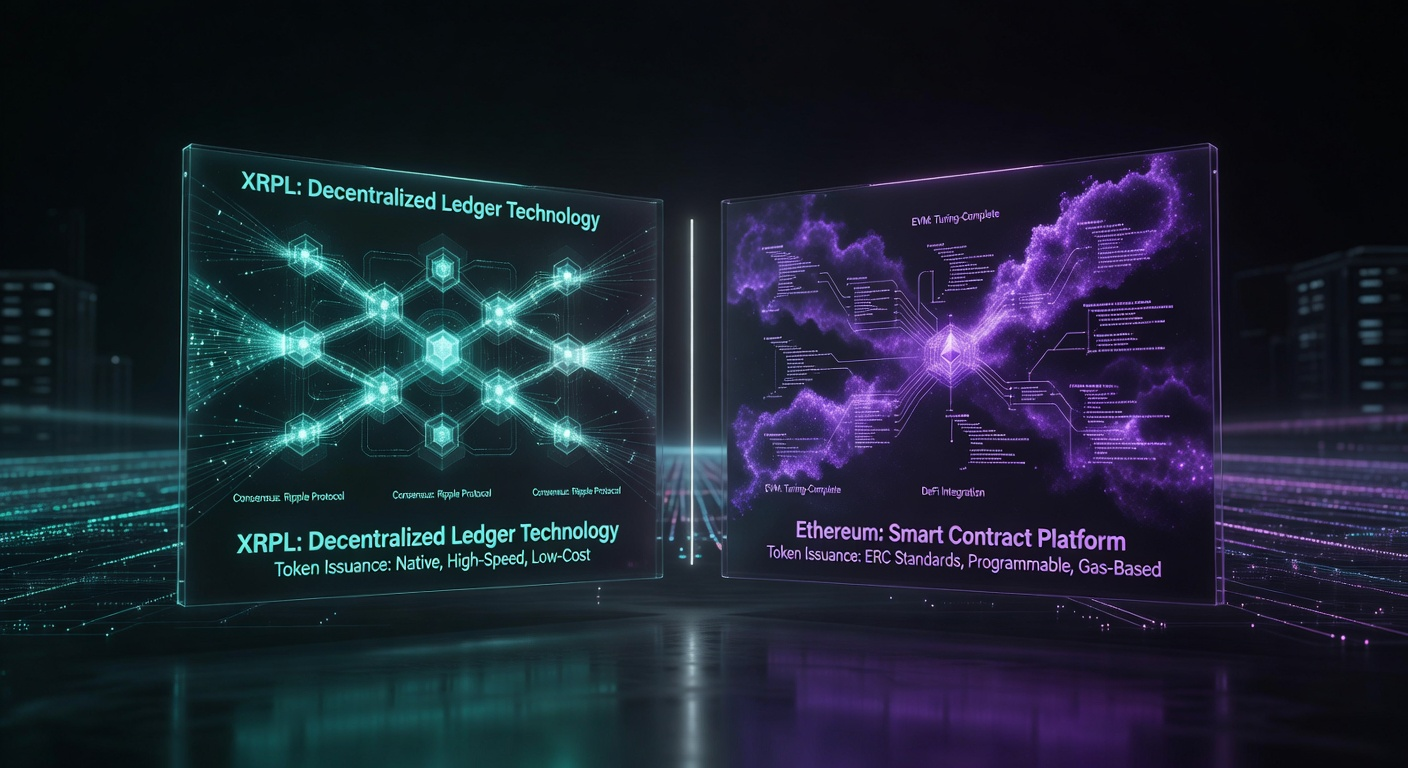
XRPL vs Ethereum for Token Issuance: A Practitioner's Comparison
Ethereum dominates the token issuance conversation. But the conversation is changing. For real-world asset tokenization — where compliance, distribution cost, and settlement finality are operational requirements — the calculus increasingly favors XRPL.
This comparison is not ideological. XRPL has real limitations. Ethereum has genuine advantages. The question is which platform serves your specific token issuance requirements — not which has the larger narrative.
Head-to-Head: Every Metric That Matters
| Factor | XRPL | Ethereum |
|---|---|---|
| Transaction cost | ~$0.0002 (fixed) | $0.50–$50+ (variable gas) |
| Settlement time | 3–5 seconds, absolute finality | 12–15 sec block, probabilistic |
| Token standard | Native protocol (no smart contract) | ERC-20 smart contract |
| Developer requirement | None for basic issuance | Solidity dev or audited template |
| Smart contract exploit risk | None (no contracts) | Real — reentrancy, overflows, etc. |
| Built-in DEX | Native order book DEX | No (requires Uniswap or similar) |
| Compliance controls | Native (freeze, clawback, require-auth) | Must be coded into contract |
| DeFi ecosystem | Growing, AMM added 2024 | Dominant — Uniswap, Aave, Compound |
| Regulatory clarity | High (SEC case resolved 2025) | Ongoing in some jurisdictions |
| Energy per transaction | ~0.0079 kWh (consensus) | ~0.02 kWh (PoS post-Merge) |
Where XRPL Has the Structural Advantage
Distribution Economics at Scale
This is the most concrete, operational difference. If you're distributing tokens to 1,000 holders — or distributing income to existing holders monthly — the cost differential is enormous and cumulative.
Distributing to 1,000 addresses on XRPL: approximately $0.20. The same operation on Ethereum mainnet during normal gas conditions: $2,000–$5,000. Even on Layer 2 (Arbitrum, Optimism), you're looking at $10–$100, plus the operational complexity of managing L2 bridges.
For real estate tokens distributing monthly rental income, for royalty tokens distributing quarterly, for any token issuer paying out distributions regularly — this cost difference compounds into tens or hundreds of thousands of dollars annually at meaningful scale.
Zero Smart Contract Attack Surface
ERC-20 tokens exist as Solidity bytecode. That bytecode has an attack surface. The history of Ethereum token contracts includes reentrancy exploits, integer overflow vulnerabilities, access control bugs, and proxy upgrade errors — each costing real money. A production-grade ERC-20 security audit from a reputable firm costs $10,000–$50,000, and even audited contracts get exploited.
XRPL tokens have no smart contract surface. Token mechanics — issuance, transfer, freeze, clawback, burn — are implemented at the protocol level in code that has been running and battle-tested since 2012. There is no contract to audit, upgrade, or exploit.
Native Compliance Architecture
For regulated securities, XRPL's compliance controls are protocol-native rather than custom-coded:
- RequireAuth: Only authorized wallets can hold your token — KYC/AML gating built in
- GlobalFreeze: Pause all transfers for regulatory action — one transaction, instant effect
- IndividualFreeze: Freeze specific holders without affecting the broader market
- Clawback: Court-ordered or fraud-recovery token retrieval, protocol-enforced
- TransferFee: Issuer captures a percentage of secondary market trading automatically
On Ethereum, implementing equivalent functionality requires custom Solidity code, a security audit, and gas fees for every whitelist update. The compliance feature set costs $20,000–$50,000 to implement correctly on Ethereum. It costs nothing to configure on XRPL.
You're issuing regulated securities that need compliance controls built in. You need high-volume distributions at minimal cost. You want no-code or low-code token issuance. You're tokenizing real-world assets. You need institutional-grade settlement finality with no reorg risk.
Where Ethereum Maintains Its Lead
DeFi Composability
If your token needs to integrate with Uniswap liquidity pools, Aave lending markets, Compound money markets, or any of the hundreds of established Ethereum DeFi protocols — you need ERC-20. XRPL has its own AMM and native DEX, but the Ethereum DeFi ecosystem is orders of magnitude larger in total value locked and protocol maturity.
For DeFi-native applications where your token's value proposition depends on integration with existing protocols, Ethereum is the correct choice and XRPL's advantages become irrelevant.
General-Purpose Programmability
Ethereum's EVM is Turing-complete. You can implement arbitrarily complex financial logic: dynamic pricing curves, conditional vesting schedules, algorithmic buyback mechanisms, multi-sig governance with time locks. XRPL intentionally is not Turing-complete. Hooks (XRPL's lightweight smart contracts) add programmability at the margins, but XRPL was designed for payments and tokenization, not general computation.
Your token needs to integrate with existing DeFi protocols. You require complex programmable token logic. Your investors specifically expect ERC-20 compatibility. You're building NFT infrastructure in an ecosystem built on Ethereum tooling.
The Decision Framework for Issuers
Ask these four questions:
- Do you need DeFi liquidity protocol integration? If yes, Ethereum. If no, continue.
- Does your token require compliance controls (KYC gating, freeze capability)? If yes, XRPL wins on cost and simplicity.
- Are you making regular distributions to many holders? If yes, XRPL's cost structure is transformative.
- Do you need complex programmable token logic? If yes, Ethereum. If standard issuance/transfer/freeze operations suffice, XRPL.
For the majority of real-world asset tokenization — real estate, equipment, royalties, commodities, private equity — questions two and three dominate, and XRPL wins both on data.
The Emerging Multi-Chain Reality
The practical answer for large-scale tokenization infrastructure may be both. Issue the token on XRPL for settlement efficiency and compliance. Build bridges to Ethereum for DeFi integration and investor access. Use XRPL's RLUSD as the USD settlement layer while providing ERC-20 equivalents for investors who prefer the Ethereum ecosystem.
The chains are not in competition. They serve different parts of the stack. XRPL handles settlement. Ethereum handles programmable finance. Choosing one to the exclusion of the other is a false constraint — as multi-chain infrastructure matures, the question becomes less "which chain" and more "which chain for which operation."
Issue Your XRPL Token in 5 Minutes
OnRampDLT handles the two-wallet setup, compliance flags, metadata, trust line distribution links, and DEX listing — no Solidity required. Start with testnet for free.
Start Free →