XRPL vs Ethereum for Asset Tokenization: The Data-Driven Comparison
Eight factors. Quantitative data where available. The goal is a decision framework for practitioners choosing infrastructure for real-world asset tokenization — not a chain preference argument.
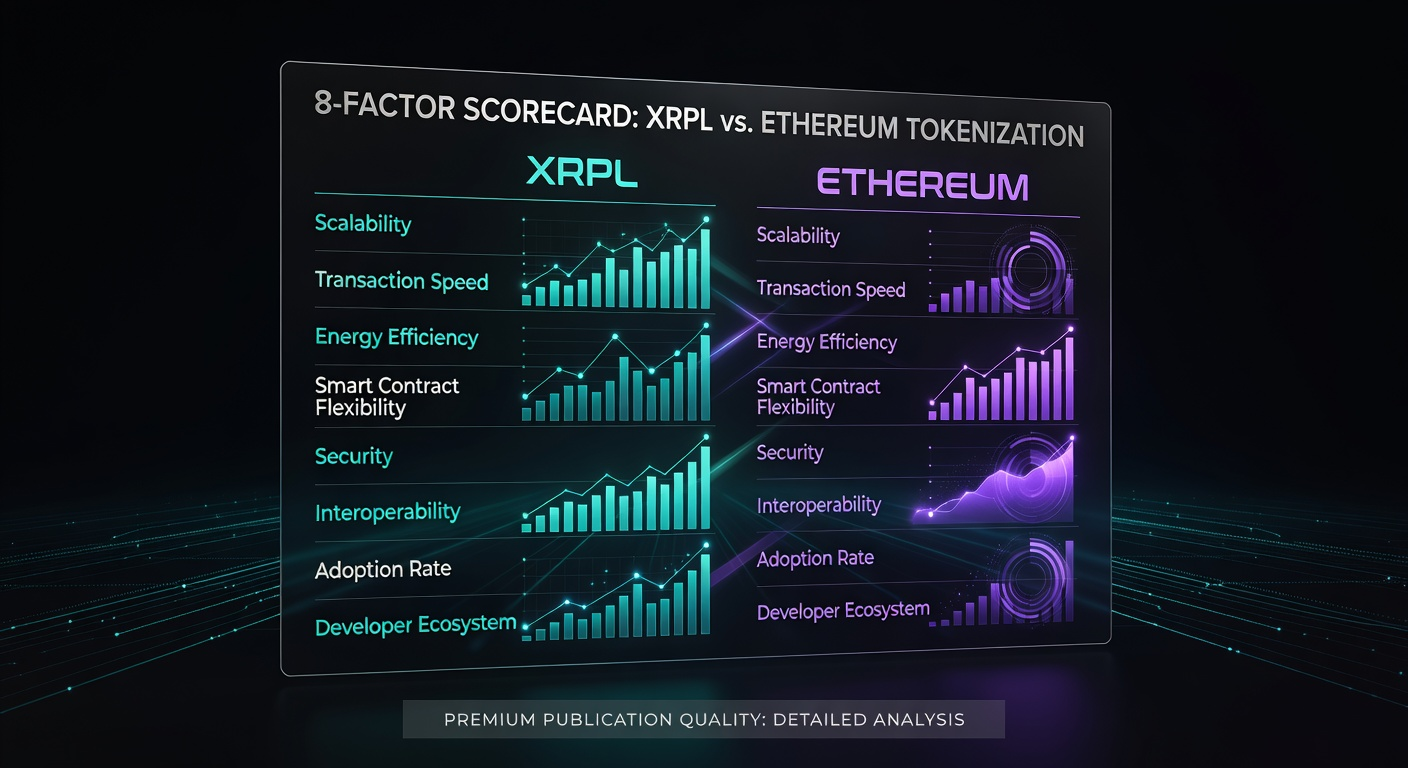
The Summary Matrix
| Factor | XRPL | Ethereum |
|---|---|---|
| Transaction fee | ~$0.0002 (fixed) | $1–$50+ (variable) |
| Settlement time | 3–5 seconds, absolute | 12–15 sec, probabilistic |
| Token creation | Native protocol feature | Smart contract required |
| Built-in DEX | Yes, order book | No (Uniswap etc.) |
| Compliance features | Native (freeze, clawback, auth) | Custom code required |
| Carbon footprint | ~0.0079 kWh/tx | ~0.02 kWh/tx (post-Merge) |
| DeFi ecosystem | Growing | Dominant |
| Smart contract flexibility | Limited (Hooks) | Turing-complete (Solidity) |
Factor 1: Transaction Fees — The RWA Multiplier Effect
Transaction costs are an operational variable that compounds at scale. For a one-time token deployment, even $500 in gas fees is a minor expense. For ongoing operations — regular distributions, secondary market trading, whitelist management — the cost differential becomes structural.
XRPL: ~0.00001 XRP per transaction ($0.0002 at current prices). Fixed. Burns out of supply rather than going to validators, which removes the incentive to manipulate fees upward. During peak network activity, XRPL fees do not spike the way Ethereum gas does.
Ethereum mainnet: Variable gas auction. Normal conditions: $2–$5 for simple transfers, $15–$50 for contract interactions. During NFT drops or DeFi liquidation cascades: $100–$500.
Layer 2 solutions reduce Ethereum fees to $0.10–$1 but add bridge complexity and split liquidity across chains. XRPL mainnet at $0.0002 remains cheaper than most L2 operations without the overhead.
Real-world impact: Monthly RLUSD distributions to 500 real estate token holders: $0.10 on XRPL. $500–$2,500 on Ethereum mainnet. Over a 10-year investment horizon, this is $60,000–$300,000 in cumulative fee differential for a single token issuance.
For any RWA application with ongoing distribution requirements, the XRPL cost structure is transformative at scale. This is the single most operationally significant factor for high-distribution RWA tokens.
Factor 2: Settlement Finality
XRPL uses Byzantine Fault Tolerant consensus. Each ledger close is absolute — a validated transaction cannot be reversed or reorganized. There is no concept of "safe after N confirmations" because the first confirmation is final.
Ethereum post-Merge uses probabilistic finality. Block producers propose blocks; attesters vote on them. "Economic finality" is achieved after ~12 minutes (2 epochs of 64 slots each). For practical purposes, single confirmations are accepted in most applications — but the theoretical reorg risk exists at low probability.
For institutional counterparties and regulated securities, absolute settlement finality is a meaningful underwriting criterion. XRPL's BFT model eliminates settlement risk entirely. Ethereum's probabilistic model, while low-risk in practice, cannot make the same categorical statement.
Absolute finality in 3–5 seconds is a strict improvement over probabilistic finality at any speed. For regulated securities and institutional applications, categorical settlement risk elimination matters.
Factor 3: Token Creation Friction
On XRPL, token creation is a protocol-native operation. No contract deployment, no Solidity knowledge, no gas cost for deployment, no code to audit. Total time: 2 minutes with a tool like OnRampDLT. Total cost: $0.0002.
On Ethereum, creating a token requires deploying a Solidity contract. Using an audited template (OpenZeppelin ERC-20) reduces risk but doesn't eliminate it. Deployment costs: $50–$500 in gas. Getting the compliance features (whitelisting, pause, freeze, clawback) into the contract correctly requires either significant Solidity expertise or expensive custom development. Audit costs for production-grade ERC-20 with compliance features: $10,000–$50,000.
The absence of smart contract risk is not merely a cost savings — it's a categorically different security posture. XRPL's protocol-native token mechanics have no exploit surface. ERC-20 contracts, even audited ones, are code that can contain bugs.
Factor 4: Native DEX Liquidity
The XRP Ledger's order book DEX is built into the protocol at the same level as token transfers. A token issued on XRPL is immediately tradeable on the DEX against XRP and any other XRPL asset. Auto-bridging routes trades through XRP as a bridge currency if direct pairs don't exist. No listing fees, no liquidity pool bootstrapping, no approval required.
Ethereum requires external DEX deployment. Uniswap requires providing liquidity upfront (capital cost, impermanent loss risk). Centralized exchange listings require approval processes and listing fees ranging from $50,000 to $500,000+ at major venues.
Native DEX means any token has instant secondary market availability from day one. For RWA tokens where investor liquidity is a key selling point, this is a critical infrastructure advantage.
Factor 5: Compliance Feature Architecture
XRPL's compliance features (RequireAuth, GlobalFreeze, IndividualFreeze, Clawback, TransferFee) are protocol-native. They work identically for every token on the ledger. They require no custom code. They execute with a single signed transaction from the issuing account. They have never been exploited because they are part of the consensus protocol, not separate bytecode.
Ethereum compliance features must be coded into each token contract individually. Each implementation can differ. Each requires separate auditing. Each carries independent exploit risk. Updating a whitelist costs gas on every operation.
For regulated securities, compliance features are not optional. Having them native to the protocol rather than dependent on custom code quality is a structural advantage that institutional compliance teams will notice.
Factors Where Ethereum Leads
DeFi Composability
Ethereum's DeFi ecosystem — Aave, Compound, MakerDAO, Uniswap — represents hundreds of billions in total value locked and years of protocol development. If your tokenized asset needs to integrate as collateral in lending protocols, or be traded across automated market makers, Ethereum is the correct choice. XRPL's ecosystem is growing but cannot match this depth in 2026.
General Programmability
Turing-complete EVM allows any financial logic: algorithmic pricing, complex governance, conditional payouts, decentralized insurance. XRPL's Hooks add programmability at the margins but XRPL was not designed for general computation. For tokens requiring custom on-chain logic beyond standard issuance and compliance operations, Ethereum is more capable.
The Scenario-Based Decision
Tokenizing a rental property and distributing income monthly: XRPL. Compliance controls native, distribution cost negligible, finality absolute.
Issuing a token as collateral in an Aave lending market: Ethereum. You need DeFi composability that doesn't exist on XRPL at this scale.
Distributing royalties to 2,000 IP investors quarterly: XRPL. $0.40 per distribution versus $400–$4,000 on Ethereum mainnet.
Building a decentralized options protocol on your tokenized asset: Ethereum. You need programmable financial derivatives logic beyond what XRPL supports.
Issuing a regulated bond to 300 accredited investors: XRPL. Native RequireAuth, RLUSD interest payments, absolute finality, and compliance controls at near-zero cost.
Issue Your RWA Token on XRPL
OnRampDLT provides the token issuance infrastructure — compliance controls, distribution management, and native DEX integration — built for serious XRPL tokenization projects.
Start on Testnet →