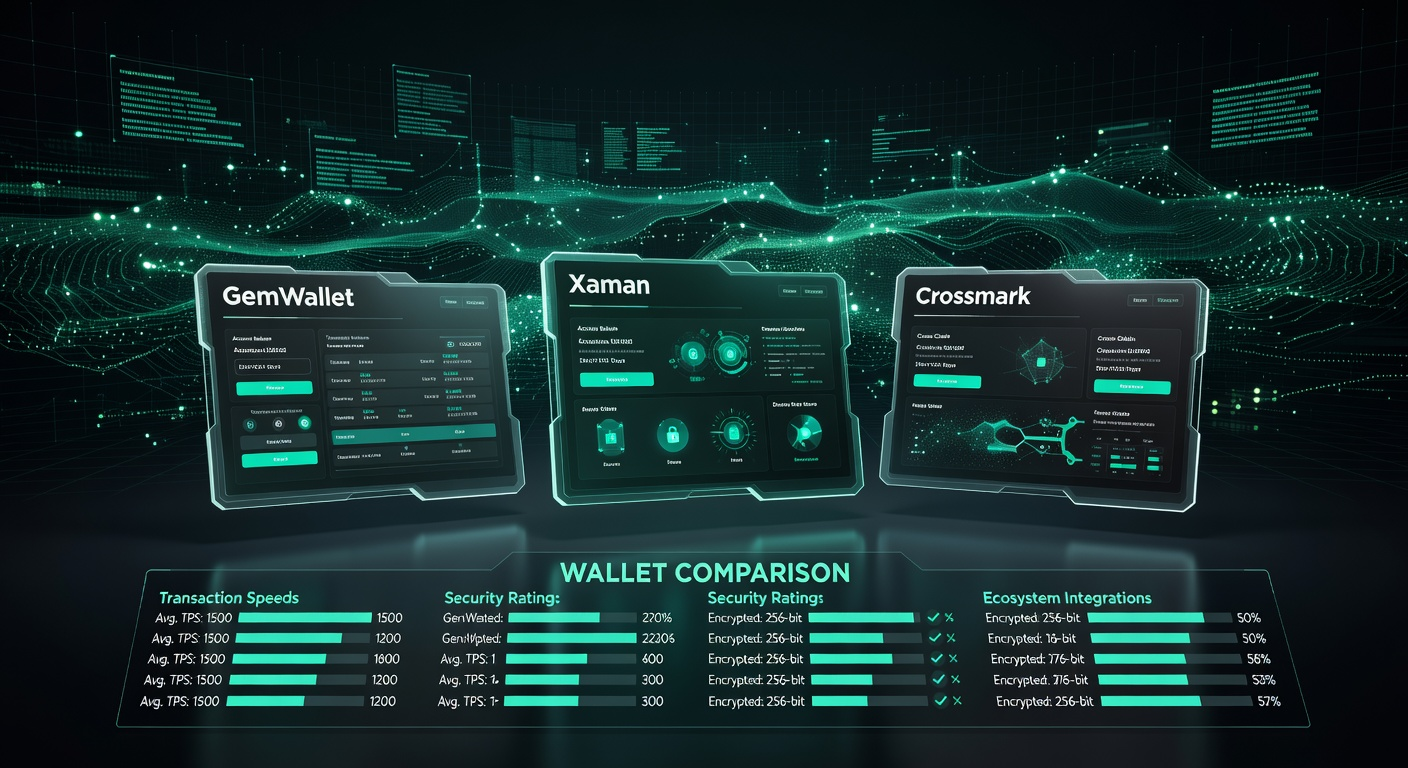
XRPL Wallets 2026: GemWallet vs XAMAN vs Crossmark
Your wallet choice affects more than your own experience. For token issuers, the wallets you support determine how frictionless or painful the onboarding experience is for your holders. Here's the technical breakdown.
The three dominant XRPL wallets — GemWallet, XAMAN (formerly XUMM), and Crossmark — cover the full range of XRPL users: mobile-first retail investors, desktop power users, and developers building integrations. They are not interchangeable. Each has distinct SDK capabilities, UX assumptions, and target audiences.
For token issuers, the question is: which wallets do you build your distribution flow around, and which do you recommend to your holders?
Quick Comparison Matrix
| Feature | GemWallet | XAMAN | Crossmark |
|---|---|---|---|
| Platform | Chrome Extension | iOS + Android | Chrome Extension |
| Mobile | No | Native | No |
| Developer JS SDK | Yes (best-in-class) | Yes (xumm-sdk) | Yes |
| Trust line UX | Excellent, 1-click | Excellent, QR flow | Good |
| Hardware wallet | Ledger (partial) | Ledger + Tangem | Ledger |
| Built-in DEX trading | Basic | Full order book | Basic |
| NFT support | Yes | Yes | Yes |
| Primary user base | Developers, desktop | Mobile, retail | Power users, devs |
GemWallet — The Developer's First Choice
GemWallet is a Chrome extension built for developers and desktop-first users. Its JavaScript SDK is widely regarded as the cleanest developer experience on XRPL — async/await APIs for connection, transaction signing, trust line creation, and NFT operations that integrate easily into React or any web application.
For token issuers building web applications, GemWallet's SDK allows you to trigger trust line creation programmatically — your distribution page detects GemWallet, calls the SDK to pre-populate the trust line transaction, and the user approves in one click. No wallet address entry, no currency code typing, no risk of user error.
XAMAN — The Mobile Standard
XAMAN is the dominant XRPL wallet for non-developer users. The mobile application guides users through complex XRPL operations — trust line creation, DEX trades, token transfers — with UX that doesn't require any understanding of the underlying mechanics. QR code signing flows and XUMM-specific deep link protocols make XAMAN the standard for investor onboarding.
For token issuers distributing to retail or semi-retail audiences, XAMAN is where most of your holders will be. The deep link format allows your distribution page to generate a URL that, when tapped on mobile, opens XAMAN directly with the trust line or payment pre-configured. Tangem hardware wallet integration makes it viable for holders with larger positions who want hardware security without losing mobile convenience.
Crossmark — The Power User Extension
Crossmark handles a broader range of XRPL transaction types than GemWallet, including complex escrow operations and multi-account management. It has strong Ledger hardware wallet support — particularly useful for issuers managing cold wallet signing operations. Crossmark's active development track means it tends to support newer XRPL features quickly.
The trade-off is a smaller user base compared to XAMAN. For distributions to accredited or institutional investors who are likely to already have XRPL wallets configured, Crossmark is a reasonable primary option. For consumer distributions where you're onboarding new XRPL users, the smaller install base creates friction.
Issuer Strategy: Which Wallets to Support
The operational answer is: support all three, with clear priority guidance for your holder audience.
Build your distribution page to detect and offer connection for all three wallets. When a holder visits, they connect whatever wallet they already have — no forced migration, no wallet preference imposed. This eliminates the wallet friction that causes drop-off in token distribution flows.
Then, in your documentation and onboarding emails, recommend:
- Non-technical or first-time XRPL users: XAMAN on mobile. The guided UX makes the learning curve manageable.
- Crypto-native desktop users: GemWallet. Familiar extension model, clean UI.
- Institutional or high-net-worth holders: XAMAN + Tangem or Crossmark + Ledger. Hardware-backed wallet security for larger positions.
Trust Line Deep Links: The Technical Layer
The operational capability that makes multi-wallet support viable is the deep link — a URL format that opens a specific wallet app with a transaction pre-populated. All three wallets support deep links or SDK-based trust line pre-population.
For XAMAN: the XUMM xApp and payload API allow you to create a signing request server-side that, when the holder opens the link on mobile, launches XAMAN with the exact transaction ready to sign. For GemWallet and Crossmark: their JavaScript SDKs allow your web page to call the extension directly and pass the trust line parameters without the user navigating away or manually entering anything.
When implemented correctly, holder onboarding looks like this: holder receives distribution email → clicks link → wallet opens with trust line pre-filled → holder taps approve → trust line is established → holder receives tokens. No blockchain knowledge required.
Your Token Distribution, All Three Wallets
OnRampDLT's distribution flows connect to GemWallet, XAMAN, and Crossmark natively. Your holders use the wallet they already have. No custom wallet integration work required.
Issue Your Token →